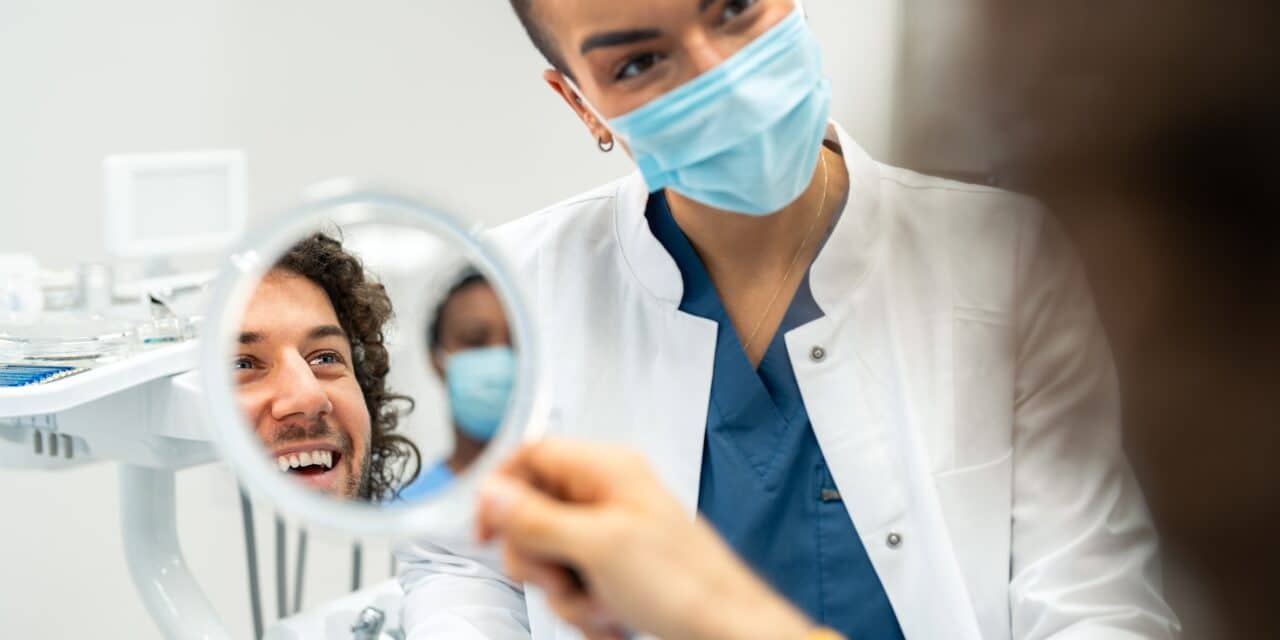
Digital workflows enable clinicians to map the final outcome on day one, transforming finishing from a reactive art of wire bending into a proactive science of precision planning.
By Alison Werner
For decades, the final stages of orthodontic treatment were often a reactive process of wire bends, bracket repositioning, and iterative refinements. Finishing was a destination arrived at through a series of in-treatment adjustments, a process that could extend timelines and introduce unpredictability. Today, a fundamental shift is underway, as digital workflows enable orthodontists to plan the finish before treatment even begins, transforming a reactive art into a proactive science.
This evolution is not confined to a single appliance type. The same principles of digital planning, customization, and data-driven oversight that defined the rise of clear aligners are now being applied with equal force to fixed appliances. By leveraging tools like CBCT imaging, AI-assisted software, and customized brackets and wires, clinicians are gaining unprecedented control over treatment from day one. The goal is no longer just to treat cases faster, but to achieve higher-quality, more consistent results with fewer detours along the way.
Across practices, this proactive approach is changing the nature of the finishing process itself. Refinements are becoming smaller and more targeted, repositioning appointments are dwindling, and the conversations around treatment outcomes are happening at the initial consultation, not in the final months. For many, it’s about starting with the end in mind, using digital tools to build a precise roadmap that guides the case to a predictable and high-quality conclusion.
From Reactive to Proactive
The core of this transformation lies in moving from a reactive to a proactive clinical mindset. In the analog era, treatment often involved a degree of trial and error. “A lot of your stuff from an analog [system], in my opinion, it’s very reactive, whereas digital setups and digital orthodontics allows you to be proactive in your approach,” says Evan Perkins, DDS, MSD, who practices in Fort Worth, Texas. After taking over a conventional, paper-chart practice, he immediately began implementing a digital workflow. “We’re planning everything from the beginning. So we’re streamlining treatments, because you’re starting with the end in mind.”
This sentiment is echoed by Cory Costanzo, DDS, MSD, of Fresno, Calif. For him, the digital workflow has completely redefined when finishing begins. “I like to say, you know, finishing starts before we put the braces on,” he explains. “We are positioning the brackets on a digital model of the teeth and then simulating how teeth are going to line up based on how you position the brackets, and fine tuning our bracket position in that manner… so kind of already seen how the case is going to finish before we even start.”
This upfront visualization eliminates the guesswork that often led to late-stage complications. “For, I don’t know, 15 years, you know, I did all this the traditional way, where we just put the brackets on and saw what happened, and then I would wonder, why did this case not work out like I thought it was going to?” Costanzo recalls. “And now that I can see that in advance on the computer, I can say, ‘Oh, that’s why. This is why this case wouldn’t have worked out if I didn’t make this change in advance.’ So it’s been an eye-opening and interesting experience.”
The Power of the Digital Setup
At the heart of this proactive approach is the digital setup, which allows for a level of precision and customization previously unattainable for both fixed appliances and aligners.
For bracket cases, this can mean moving beyond one-size-fits-all prescriptions. Perkins, who uses 3D-printed custom brackets from LightForce, was driven by a fundamental question from his residency: “Why have we not created something like a bracket and a custom prescription to fit the patient, as opposed to fit all of our patients in this certain box that is going to get us close, but it’s not designed for everybody?” he asks. Customization answers that question by treating each tooth as unique. “From a custom system, every tooth is treated different, so the torque can be different,” he explains, adding that by customizing the torque for each tooth, the system removes the need for the reactive wire adjustments that define traditional mechanics.
This customization, combined with digital indirect bonding and customized wires, is creating significant efficiencies. In Chicago, Neil Warshawsky, DDS, MS, reports that using custom fixed appliances has dramatically streamlined his practice. “We probably cut out, I think the number is about 38% of our visits compared to pre-COVID,” he says. Costanzo has integrated robotically bent wires into his workflow after the initial alignment. “We are scanning and ordering SureSmile wires, which are all robotically bent, and that’s getting us to the finish a little bit quicker,” he notes.
On the aligner side, the digital setup has empowered orthodontists with granular control over the treatment plan. Where clinicians once had to request changes from a technician with varying results, they now can directly manipulate the staging of tooth movements. “With SureSmile, I have full control over the entire planning and staging process,” Costanzo says. “I now have 100% control over the staging process, which allows me to dial in the aligner staging much better than I ever could.”
This control allows him to identify and eliminate biomechanical conflicts before the aligners are even fabricated. “Now I can see all of the numbers that go into the staging. I can see how every tooth is moving at every stage, in every direction which I couldn’t see before,” he says. “You kind of see, ‘Hey, how can I be moving this tooth mesially in this stage and also trying to tip it distally?’ Those two movements are not going to work very well together. And now that I can see those and separate those out in the staging, I think that’s what’s allowing the aligners to track better.”
Deeper Diagnostics, Better Plans
A more predictable finish begins with a more comprehensive diagnosis, and for some, Cone Beam Computed Tomography (CBCT) has become an indispensable tool. It provides a three-dimensional view of the patient’s anatomy that informs a more robust and realistic treatment plan.
Costanzo integrates CBCT scans for nearly all his aligner cases. “It allows us to do our plan and see how the roots are moving through the bone, and make sure we’re paying attention to the bony limits that we have with each patient,” he says. “So that, I think, is giving us a better plan.”
Warshawsky goes a step further, considering CBCT a mandatory diagnostic record for every patient. “I only have a CBCT. So yes, all four of my offices, we only have a CBCT,” he states, noting that a low-dose CBCT delivers less radiation than a traditional panorex and cephalometric X-ray combination. The diagnostic value, he argues, is unparalleled. “What you can’t see in a pan and ceph is a volumetric assessment of an airway. You just can’t,” he says. “You can’t look at the inside of the nose and say, ‘Oh, my God, your medial turbinate is completely swollen. You need to go see someone.’”
This holistic view reinforces a broader perspective on the orthodontist’s role. “I’m tired of people looking at me as a tooth mechanic. I work in a freaking hospital… We are oral care medicine,” Warshawsky asserts. By identifying underlying issues like airway constriction at the outset, the treatment plan can address foundational problems, leading to a more stable and healthier long-term result.
This depth of information also enhances patient communication. Digital simulations, built from scan and CBCT data, make complex treatment options tangible. Costanzo finds this particularly powerful for extraction cases. “When I can show them simulations of, ‘Hey, this is how your teeth are going to turn out if we don’t take any teeth out, this is how they’re going to turn out if we do take teeth out,’ and show them how the roots are going to move within the bone… that’s been huge,” he says. “If a picture is worth 1,000 words, then a digital simulation is worth 10,000 words.”
In-Treatment Oversight
While a strong initial plan is crucial, digital tools are also changing how orthodontists monitor progress and make course corrections. Remote monitoring platforms, in particular, offer a new layer of oversight, though opinions on their direct impact on refinements vary.
Warshawsky, who relies on the OrthoFX system, considers it an essential component of aligner therapy. “I think it’s mandatory in the clear aligner world that you run teledentistry with your case,” he says. The weekly check-ins provide an opportunity to catch tracking issues before they derail the case. “You can check in and say, ‘You know, it’s not quite seated all the way. Wear it an extra week.’ That’s the difference between refinements and finishing on time.”
Costanzo, who has used remote monitoring for several years, has a more nuanced view. While it allows him to track patients more closely, he finds it sometimes extends the initial treatment phase. “Oftentimes the remote monitoring tells the patient, ‘Hey, you’re not ready to switch to the next aligner. Keep wearing your current aligner for a little bit longer,’” he explains. “Hopefully the goal there is that it does reduce the need for refinement… I think I’m still too new to be able to say that that’s happening for sure, but it’s definitely been a nice feature.”
For Perkins, the decision to use remote monitoring is case-dependent, driven largely by patient preference. “I do for some, it’s really individually based,” he says. “Some of our patients would come back and they’re just saying, ‘Oh, it’s another thing I have to do.’… Some still want to be seen—they still want to come into the office.”
A Better, More Consistent Outcome
Ultimately, the drive toward a digital, proactive workflow is about more than just efficiency or reducing the number of refinement scans. The ultimate goal is to elevate the quality and consistency of the final result.
“My primary goal in all of these different digital treatment modalities is trying to find anything that helps me get a better result,” Costanzo says. “I’m not necessarily the orthodontist that’s trying to treat cases quicker. Sure, it’s great when that happens, but I’m more interested in getting as good of a final result as I can. I feel like it’s really improved the quality of my final outcome.”
Perkins agrees, noting that customization inherent in digital systems reduces the clinical “noise” that can compromise results. “Your outcomes become, in my opinion, better. They become more consistent,” he states. “There’s more error introduced in the system with the non-custom analog appliances, because, again, you’re fitting everybody into that certain box.”
By leveraging digital tools to plan with the end in mind, orthodontists are not just changing their workflows; they are raising the standard of care. They are ensuring that the path to a great finish is no longer a winding road of adjustments, but a direct route paved with data, precision, and predictability. OP
Photo: © Dorde Krstic | Shutterstock.com
Alison Werner is chief editor of Orthodontic Products.