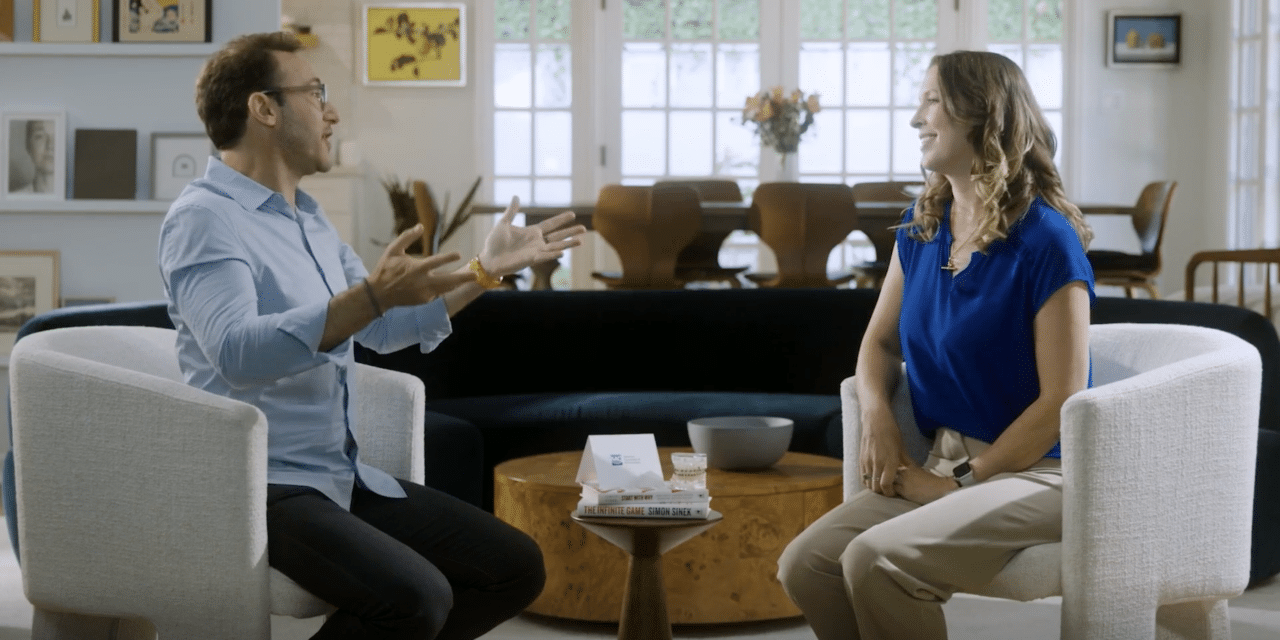
The AAO partnered with leadership expert Simon Sinek to teach orthodontists skills that have nothing to do with biomechanics—and everything to do with running a practice people want to work in.
By Alison Werner
Orthodontists spend years mastering the clinical intricacies of their specialty—biomechanics, treatment planning, case management. But when it comes to leading a team, communicating with patients, or navigating the emotional demands of practice ownership, most will say the same thing: no one taught them how.
That gap is what prompted the American Association of Orthodontists (AAO) to partner with leadership expert and bestselling author Simon Sinek on the Simon Sinek–AAO Inspiring Leadership program, a six-module, self-paced online certificate course designed to help orthodontists overcome burnout, reduce workplace conflict, communicate more effectively, and build a practice culture where both they and their teams can thrive.
Launched in October 2024, the program has now been completed by more than 600 orthodontists and over 80 office managers. The next cohort begins January 28, 2027. For the orthodontists who have gone through it, the program has delivered something that clinical continuing education rarely touches: a deeper understanding of themselves and the people around them.
Filling a Gap in Professional Education
Mindi Brothers, vice president of strategy and innovation, who oversees the program at the AAO, says the idea grew out of focus groups with younger members who reported feeling unprepared for the leadership demands of running a practice. Broader surveys confirmed the need extended across career stages.
“Even though an orthodontist may have been in practice for 20-plus years, who they’re leading and who they’re managing is different,” Brothers says, pointing to the multigenerational workforce now common in orthodontic offices. “The feedback that we’ve gotten from older members as well is, ‘Wow, this has really helped me because of just how different my team is than they used to be.'”
The program pairs Sinek’s content—drawn from his books Start with WHY, Leaders Eat Last, and The Infinite Game—with orthodontist-led segments that translate each module’s concepts into actionable practice strategies. Collaborators include retired Navy SEAL Rich Diviney, organizational psychologist Zach Mercurio, PhD, and restaurateur Will Guidara, author of Unreasonable Hospitality. At the close of each module, an AAO-member orthodontist provides a real-world application segment, bridging Sinek’s broader leadership principles with the day-to-day realities of orthodontic care.
Kaitrin Kramer, DDS, MS, PhD, a craniofacial orthodontist at Nationwide Children’s Hospital in Columbus, Ohio, and one of the program’s AAO instructors, says the orthodontist-specific component is what sets it apart. “It’s unique to take everything that [Sinek] talks about and then have somebody really dissect that in a granular way that you can use right away [in your practice],” she says.
Reconnecting With Purpose to Combat Burnout
A central thread running through the program is Sinek’s concept of “finding your why”—the deep-seated purpose that drives an individual’s work. For orthodontists feeling the weight of daily production pressures, staffing challenges, and the monotony of routine, reconnecting with that purpose can be transformative.
“I think that people burn out when they feel like they’re on a wheel,” Kramer says. “They’re just going from one thing to the next, and there’s nothing that’s connecting them anywhere. When you lose connection to your why is where burnout comes from.”
India Collier, DMD, a nine-year practitioner who is opening her own practice in Atlanta this fall, took the program last year as she prepared for hiring and building a team from scratch. The final module, in which participants draft a personal why statement, was initially daunting and unlike any professional self-reflection exercise she’d done before, but it left a lasting impression. “My final why statement is to empower others to rise through adversity, so that we dare to imagine what’s possible for our own lives,” she says.
Once defined, a why becomes more than a personal mantra—it becomes the foundation everything else in a practice is built on. “Your why is your purpose,” Brothers says, “and it’s how you build, how you lead, how you formulate the practices and procedures around that why, so that your entire practice is focused on something much more inspirational than just transactional.”
For Nathan Hamman, DDS, MDS, who owns a practice in Southaven, Mississippi, what began as a desire to serve the community evolved into something more specific as he worked on his why. “I’ve discovered [my why] is to create an environment, a workplace where I’m happy and my team’s happy,” he says. “I want to make a place where people just love coming to work.”
From Individual Learning to Team Transformation
Hamman, who took the program shortly after it launched, did something none of the other participants interviewed for this article had done—he brought the principles back to his entire team.
Over the course of several weeks, he led his leadership team through a deep dive into the practice’s vision statement, core values, and the reasoning behind everyday operational decisions. Then the leadership team presented the updated framework to the full staff.
The result was a shift in how the team understood even routine discussions. Hamman points to the frustrating topic of bracket failures as an example: address it without first explaining the reasoning—creating a stress-free day, an easier schedule, happier patients—and the team won’t be as receptive. “But if you’ve already established that your vision is to create a place where we’re all happy and using our gifts,” he says, “they’ll better understand it and buy into the whole process.”
Hamman’s experience also underscores a candid reality about leadership development. “It doesn’t mean that all of a sudden it’s a quick fix,” he says. “For a while, it might even get tougher, because you’re forced to confront realities—situations you created by not being the best leader—that you now have to undo.”
Beyond the Why: Communication and Culture
While finding a why anchors the program, the six modules cover much more ground beyond it. Brothers describes the broader goal as building “confident communicators who can get the most out of themselves and their teams”—skills that surface in how orthodontists manage their staff, their patients, and the trust that holds a practice together.
For Kramer, the module on effective communication had an outsized impact—not only on her lecturing but on her daily patient interactions. She recalls an early professional experience lecturing to more than 100 dental students where she felt disconnected from the audience. After going through the program, she adopted Sinek’s framework of treating every interaction as an opportunity to give a gift rather than seek approval.
When asked what module stuck with Hamman, he points to one built around an interview with Diviney, the retired Navy SEAL. “[That module] really got into building trust with the team,” he says. Once that trust is established and a team buys into a shared vision, he says, decision-making doesn’t have to rest on one person. The module teaches the concept of dynamic subordination—an environment where “everybody is going to pitch in,” whether or not the practice owner is in the building that day. “They feel comfortable stepping up and being a leader because they know if they make a mistake, [I’m] not going to get down on them,” he says.
For Collier, the program reshaped how she thinks about something she once treated as a formality: onboarding new hires. “I used to think of onboarding as some paperwork,” rather than a months-long process to help a new employee feel comfortable in the office, she says. She also credits the program’s private Facebook group, where participants across career stages trade onboarding and hiring strategies, with making the process feel less solitary as she staffs her new practice. “People gave tips and tricks on what they’re doing to hire and what they like to do for onboarding,” she says.
Building for the Long Term
Collier, who also completed the AAO’s Wharton Mastering the Business of Orthodontics program, sees the two offerings as complementary pillars of professional development. “If you are not a good leader, you are not going to have staff to work in your business,” she says.
Brothers says the breadth of interest in the program has been one of its most validating outcomes. “We designed the program for members that were just starting out through what we call mid-career, so at that 15-year mark,” she says. What surprised her most was how many veteran orthodontists—some with 20-plus years in practice—signed on as well, which she calls “really validating.”
When asked what she would say to someone on the fence about enrolling, Kramer’s advice is straightforward: “See this as an investment in yourself, and don’t pass up an opportunity to invest in yourself.
Hamman puts it in even broader terms. “I don’t think most great leaders are born,” he says. “You can become a great leader, but you have got to work at it, and to do that, you have to have the right information and the right material.” OP
Photo: American Association of Orthodontists
Alison Werner is chief editor of Orthodontic Products.