

From refinement rates to Class II correction to smartphone-based setups, two orthodontists compare life before and after adopting Angel Aligner.
Switching aligner systems is rarely a small decision. It touches everything from case setup and staff workflow to how orthodontists explain treatment options in the consult room. For Christopher Teeters, DMD, MS, of Teeters Orthodontics in Peoria, Ariz, the move to Angel Aligner came after trying five other systems and finding none that met his clinical bar. For Allison Bergdoll, DDS, MS, of Dupont Orthodontics in Fort Wayne, Ind, it came after growing frustration with her previous provider and a demo that surprised her with how far the software had matured.
Three years and hundreds of cases later, both say the shift has reshaped more than their aligner brand of choice. Refinement rates are down. Class II correction looks different. Case setups happen on a phone between morning workouts or in line at the DMV. And patients, they say, are noticing the difference in the clinical outcome.
Orthodontic Products sat down with Teeters and Bergdoll to compare notes on what changes—clinically, operationally, and in the consult room—when a practice moves to Angel.
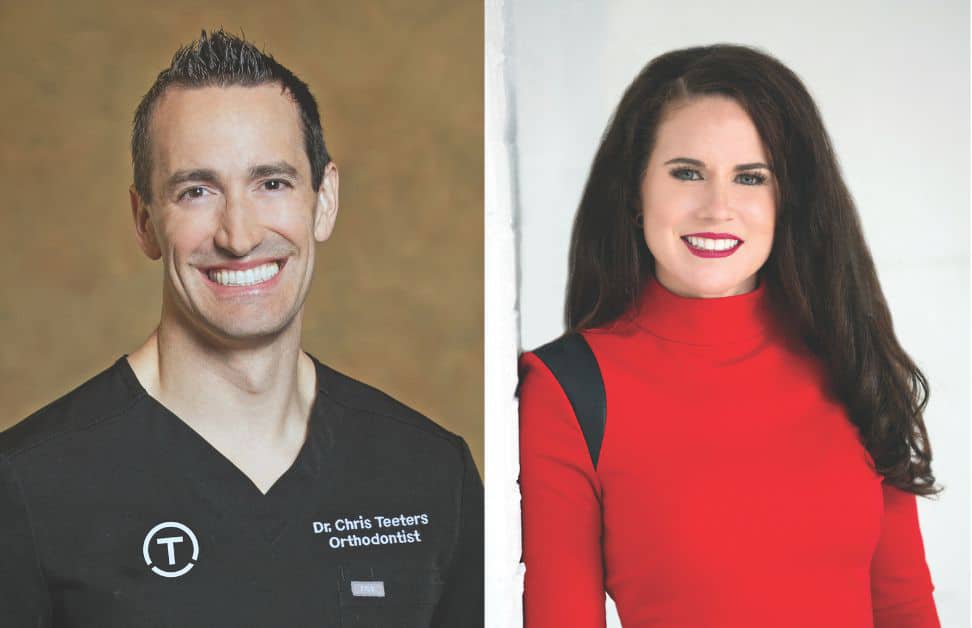
Orthodontic Products: With so many clear aligner systems on the market, many orthodontists are hesitant to switch or add another provider to their workflow. What initially prompted you to explore Angel Aligner, and what ultimately convinced you to adopt it in your practice?
Christopher Teeters, DMD, MS: I was initially attracted to Angel Aligner after having tried five other aligner systems. Originally I was skeptical—I didn’t need to try a sixth aligner system and be disappointed. But I saw a post in the Orthodontic Pearls Facebook forum by a colleague asking, ‘Has anyone heard anything bad about Angel Aligner? I’ve only heard good things.’ This group has almost 10,000 orthodontists, and not a single negative thing was said about Angel Aligner, which kind of blew my mind. So I reached out. Brooke McIntyre and Hannah Sass set me up with my first few cases, and I was blown away. I couldn’t believe how quickly I was finishing, how effective it was, and that I no longer had to bond buttons because they’re integrated into the plastic. Three years and almost 200 cases in, there’s no going back for me at this point.
Allison Bergdoll, DDS, MS: I was encouraged by one of my colleagues to give it a try. I was unhappy with my former aligner system and really wanted to make a change. He’s a very techie person and told me how great it was. I did a demo and was just blown away by how amazing it was, and I made the switch pretty quickly after that. The software was very user-friendly and intuitive—it seemed very advanced, like they had already worked out all of the kinks, which I wasn’t expecting. It was also really cool that they offered AI STL tracing, and that our patient didn’t even have to be an Angel patient in order to use that.
OP: A clinical partnership is only as good as the support behind it. How would you describe your experience working with the Angel Aligner team, and how does their approach to customer support and product development compare to other manufacturers in the industry?
Bergdoll: Truly, they’re the best. I have an amazing rep, Christine, who is our clinical integration specialist. She is super helpful and responsive. The Angel team treats us so well and responds to everything right away, so there’s not a delay in any of our cases. Recently we had a patient coming in to get revision aligners, and I’m not sure what happened to them, but we could not find them. I reached out to Christine and she had them reprinted and sent out to us the following day. We were able to keep the patient on track very easily and really didn’t miss a beat.
Teeters: My experience working with the Angel team has been one of the greatest highlights. I can reach out to my representative and get responses within minutes—definitely same day. With other companies, I’ve had to wait, or I’d get a canned response. But more importantly, Angel has been very quick to implement new ideas that have made the product so much better. We have had submissions to other aligner companies for features orthodontists have wanted for years, decades even, with no change. With Angel, it seems like every month or two they’re working on another feature. I think of it like Tesla—every time I get in the car, I get an update that the car is even better than it was. Cars usually get worse over time, but mine just continues to get better. Angel is that way. They really listen to the voice of the orthodontist and are very quick to implement, and that’s huge for me.
OP: In terms of daily workflow, how have Angel Aligner’s digital planning tools and software capabilities changed the way you manage and set up your cases?
Teeters: Without a doubt, the best thing is the iOrtho software on Android and iPhone. I’m a multitasker. In the morning I have a workout routine, and while I’m waking up I can log in on my phone and do a setup within minutes. I can send a note to the technician and get it back very quickly. One of the best parts is that it’s built from the ground up as an actual mobile app—with other companies it’s a web browser, which doesn’t display properly on a phone. Sometimes half the arch is missing or you have to zoom in and out. iOrtho is very seamless. I’d say 95% of my setups I do through there, because I can knock them out as soon as they come in—whether I’m waiting in line at the DMV or doing sit-ups in the morning. I can do it in the palm of my hand, very well and very effectively.
Bergdoll: The way they have all of the buttons laid out is just a lot more efficient. I can click on the tooth and it switches to allow me to move the teeth; I can click on the attachment and it lets me move the attachment, versus having to click somewhere else on the screen to toggle back and forth. It’s also easy to rotate the tooth or scroll—just by switching to a right-click or left-click. It makes our workflow easier.
OP: Refinement rates and predictability are major pain points for aligner providers. What changes have you observed in your refinement rates, tracking, and clinical predictability since making the switch?
Bergdoll: I know our refinement rate has reduced. With our previous aligner system, we experienced posterior open bites in a lot of cases, despite doing all the things we knew we should—extra buccal root torque in the posterior, palatal root torque in the anterior, making sure we didn’t have a tooth-size discrepancy. We have maybe had one or two posterior open bites in the hundreds of cases we’ve treated with Angel. We also feel like the rotations come out quicker; we see amazing results after just one set of aligners. A lot more of our cases finish early, and even a few without refinements, which I don’t think ever happened before.
Teeters: The refinement rate has been the best it’s ever been. I’m finishing cases for the first time with no refinements. My joke was that I’d never finished a case without bending a wire or doing a refinement—until Angel. The average number of refinements I used to have was three to four, and now we’re looking at one to two, with some at zero. I have very few cases that have had three refinements, and those are very complex cases that would take probably five or more refinements with other aligner systems. I’m also getting better tracking on stubborn lateral incisors than I have in the past. And I like that I can use big attachments where I want them—some other companies dictate specific types, but I can change the size and place large attachments on posterior teeth when I’m leveling a Curve of Spee. With the angelButton I can place full-size attachments on the canines and put buttons interproximally, over edentulous spaces, or over stainless steel crowns. Those are things not possible with any other aligner system, and it takes zero chair time.
OP: Class II correction has traditionally relied on bulky, uncomfortable appliances. How has the A6 functional appliance changed your approach to these cases, and what has been your clinical success rate?
Teeters: Without a doubt, my A6 cases stand out. I used to be a Twin Block guy—I’ve used it for over 10 years and had amazing results—but it’s bulky, unesthetic, uncomfortable, and requires two separate phases of treatment. I can’t do any tooth alignment until I finish the Twin Block. The Herbst or the big mouth piston—patients hate those, and when they break, it’s a real issue trying to come in for a weekend emergency. With A6, we’re no longer having weekend emergencies. Patients can just go to the next aligner if they lose one, and you get two aligners per package. All the discomforts of the paddle extension and expansion screw in the Twin Block, or that mouth piston with the Herbst or MARA, are eliminated. I can start moving the teeth on day one, especially for those Div 2 cases. We’re able to do patients in a single extended phase instead of two separate phases. And we’re getting better results than I was getting with the Twin Block. I’m excited to see more orthodontists adopt A6 as the functional appliance of choice.
Bergdoll: With our previous aligner system, our success with functional correction was about 50-50, and in the cases where it went wrong, it went really wrong. To date, our success rate with A6 has been 100%. So far it’s been a really efficient system for us. In general, I feel so much more confident with Angel—rotations are more predictable, tipping is more predictable, we get more opening of the bite, and certainly fewer posterior open bites. The teeth just seem to track a lot better than they did with our previous aligner system.
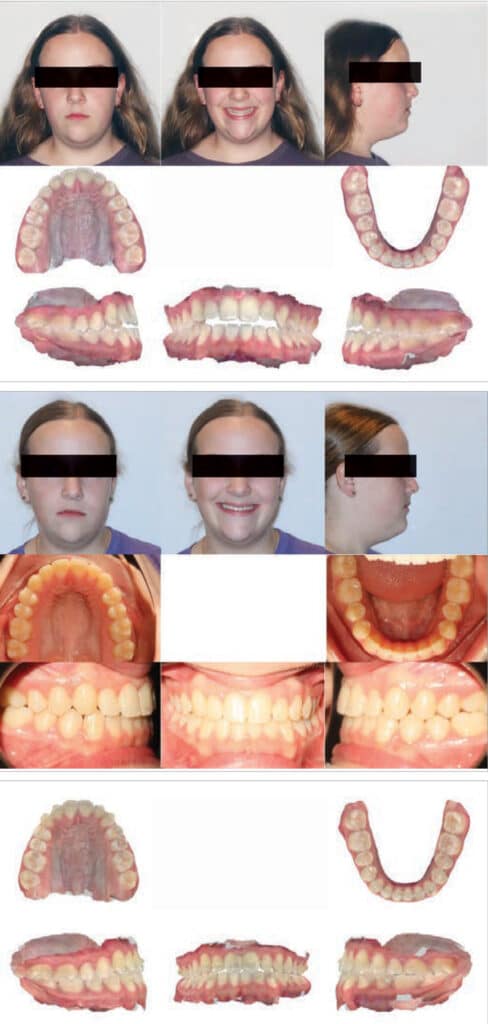
Anterior open bite case treated with Angel Aligner and posterior occlusal pads. Short roots at a 1:1 crown-to-root ratio in the premolar area were programmed for zero movement to prevent root resorption. The case finished early. Images courtesy of Dr Allison Bergdoll.
OP: Ultimately, predictability impacts both the patient experience and practice growth. Can you share a specific case where Angel achieved an unexpected outcome, and how has this technology impacted your consultations and patient satisfaction?
Bergdoll: We recently finished a case where the patient had an anterior open bite (see images above). She also had roots that were very short—not from previous orthodontic treatment, but they just never developed well, and they were at a one-to-one crown-to-root ratio in the premolar area. We were able to program in to not move those teeth in order to make sure we didn’t cause root resorption, and we were able to very predictably close down the bite using Angel Aligner and the posterior occlusal pads. We even finished her early with a beautiful, perfect result. Initially, this patient didn’t want aligners—she wanted braces—and we insisted she be treated with aligners due to the complexities. In the end, she and her parents were absolutely thrilled that they went with our recommendation.
Teeters: The biggest thing is in the TC room. It’s an easy sell to show parents and patients that they can have the buttons we need for their elastics on the plastic itself, not bonded to their teeth. They say yes to that every time. They do not want buttons on their teeth; they do not want things that can fall off. It’s such a win for the TC and for the patients. I also show patients the evolution: I show them headgear and say, ‘This is what we used to use.’ Then I show them the other options today—Twin Block, MARA, Forsus, Herbst—and finally A6, and I simply ask, ‘Which of these would you want in your mouth?’ Every time they pick A6. We get a lot of patients seeking second opinions because they don’t want those other appliances but they want the benefits of functional appliances. When they see A6, they tell their friends, and we’ve had a huge referral network from patients coming to me who want to use clear aligners instead of the alternatives. OP
Featured image: Angelalign Technology