
AI-powered search doesn’t reward the practice with the biggest budget. It rewards the one that reads the currents first and moves, and that is quietly changing who wins the recommendation.
By Jeff Slater
For most of the last decade, scale won. A DSO with fifty locations could out-spend, out-staff, and out-market an independent practice on nearly every channel that mattered. Independent practices competed on relationships and reputation and hoped it was enough.
Picture two operations working the same waters now. A DSO isn’t one giant vessel, it’s a fleet: dozens of boats built to the same specifications, running the same routine across every location. An independent practice is a single boat, maybe with a satellite location riding alongside it. AI-powered search just shifted the current, and the practice that repositions fastest, not the one running the most boats, is the one coming home with the better result.
Why AI Doesn’t Just Reward the Bigger Budget
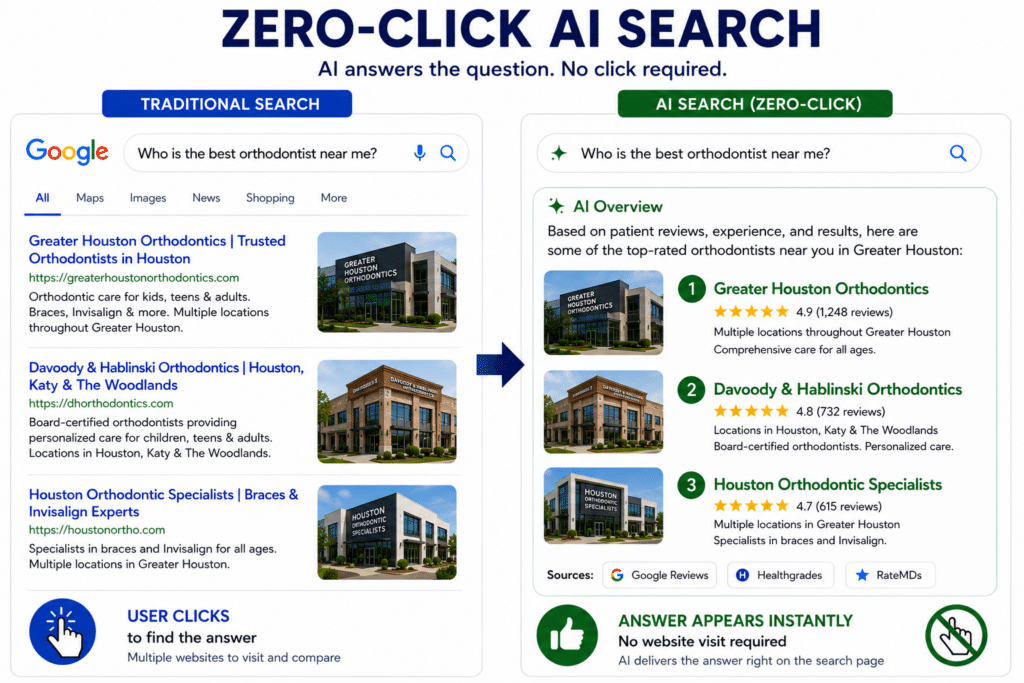
When a patient asks ChatGPT, Claude, or Google’s AI Overview to recommend an orthodontist, that system isn’t ranking ten pages and serving up ten blue links. It’s deciding which two or three sources sound like a real, credentialed, specific practice worth naming out loud, a trust decision as much as a ranking one.
According to a December 2025 study by BrightEdge, 89% of healthcare keywords showed a Google AI Overview, meaning nearly every clinical question a patient types into Google now comes back with an AI-generated answer instead of a page of blue links (BrightEdge, December 2025). A quick “orthodontist near me” search still mostly returns a map and a list. But ask Google to name the top orthodontic providers in a specific town, and you’ll probably get an AI Overview recommending three or four practices, with similar outcomes for ChatGPT and Perplexity conversations, too. Ranking well on Google no longer guarantees AI recommends you, and that should get every practice owner’s attention, DSO or independent.
One Boat vs. a Fleet
A commercial fleet’s whole advantage is standardization and scale: the same equipment and procedure, run on every boat, no matter which port it calls home. That used to be the edge. A shared template lets a DSO stand up a new acquisition’s site in weeks instead of months, with one crew running the same standing orders everywhere.
But retrofitting a whole fleet takes time, and it happens boat by boat. Expanding content, adding structured data, building real FAQ sections; all of it moves through a process built for uniformity, not speed, then repeats across every location before the fleet is current. AI retrieval systems are good at spotting what that uniformity produces: the same paragraph with a new city name swapped in, thin doctor bios, service pages that could describe any practice in the country. AI weighs authoritativeness and genuine expertise heavily (the E-E-A-T signals search engines have talked about for years, now doing double duty for AI), and equipment run identically across dozens of boats is, almost by definition, the opposite of standing out as a distinct, credible source.
A single boat doesn’t have that problem. One decision-maker, one practice’s real story. An independent practice can start deepening its written content this week and see it reflected in how AI reads the site almost immediately. That’s not a hypothetical advantage, it’s a structural one, and it’s why the practices earning AI citations increasingly are not the ones running the most locations.
To be fair, fleets can modernize. Some DSOs are already investing in decentralizing their content so individual locations sound more like themselves. But that means re-equipping every boat and getting the whole fleet moving together, which takes real time. An independent practice doesn’t have to coordinate anything; it just has to move. The chance to be an early adopter won’t sit here forever.
How the KAL AI Growth System Turns Agility Into Results
This is exactly the gap KaleidoscopeAI built the KAL AI Growth System to close. We are, first and foremost, a full-service orthodontic marketing agency; the AI system increases the frequency that AI recommends the practices we work with, not just Google.
Think of it as the instrumentation. A single boat with modern navigation equipment reads the water more accurately than a fleet still running last decade’s charts, no matter how many boats it has. Our AI Readiness Audit is the first read from the newest instruments: it scores a site across the five gaps that determine whether AI can find, trust, and cite a practice: content depth and expertise, AI-optimized content, third-party authority, local listing consistency, and structured data. The result is an AI Visibility Score out of 100. The average orthodontic practice scores below 50, meaning most of the fleet is still navigating half-blind.
None of the five gaps works alone, and there’s no single fix that earns a recommendation. AI rewards the practice whose expertise, reviews, and technical accuracy all point the same direction until the whole picture reads as trustworthy. Authority isn’t asserted, it’s confirmed from multiple directions at once.
KAL Secure keeps a 24/7 lookout from the crow’s nest, AI monitoring paired with manual review from our crew, watching rankings, listings, and site health so nothing drifts unnoticed. It’s the watch, not the voyage. KAL Amplify is where the crew opens the throttle: content built for Answer Engine Optimization (AEO) and Generative Engine Optimization (GEO), the practice of getting cited by ChatGPT, Perplexity, and Google’s AI Overviews, not just ranked by Google, run through a human editor before it publishes, paired with AI traffic analytics that show, as honestly as the industry can measure it today, where a practice’s AI-driven traffic is coming from and whether it’s growing. Neither tier requires a fleet, just a practice ready to reposition and able to see, in real numbers, which way it’s already turning.
Three Moves Every Independent Practice Can Make This Quarter
You don’t need a fleet to start moving faster than one. A few places to start, whether or not KAL is the one helping you do it:
- Audit what AI actually sees today, and read it closely. Run the questions your own patients ask (treatment cost, how long Invisalign takes, whether it hurts) through ChatGPT or a Google AI Overview and see who gets named. Don’t stop at whether you show up. Practices often appear and still get described with an outdated detail or a service no longer offered, which means someone else may be shaping the narrative before you know there’s one to control. Catch it early and it’s a correction; miss it, and AI writes your reputation for you.
- Publish the pages only your practice can write. Real case narratives, your doctor’s actual clinical philosophy, specific answers to questions patients ask at the front desk every week. Two original, expert pages a month consistently outperform twenty templated ones, because specificity, not volume, is what AI retrieval rewards.
- Keep reviews and directory data current. A steady stream of recent reviews (especially on Google, which carries more weight than Yelp, Facebook, or Healthgrades) and consistent name, address, and phone information across directories signals to AI systems that a practice is active and trustworthy right now, not just that it existed a few years ago.
None of these require a fleet’s budget. They require the willingness to be specific about one practice, which is exactly what a single, well-equipped boat is built to do.
What This Doesn’t Mean
None of this makes independence a shortcut, and no honest marketing partner should tell you it is. Being small doesn’t automatically make a practice AI-visible any more than it automatically made a practice rank well on Google fifteen years ago. The advantage shows up only when a practice invests in the fundamentals: structured data, direct-answer content, a steady stream of fresh reviews. Crew size was never the deciding factor. The clarity and evidence behind the content is, and that’s something one well-equipped boat builds faster than a fleet can retrofit.
The Window Won’t Stay Open
AI-powered search is still early, which is exactly why this moment matters. Practices that build genuine authority now, one clear, original page at a time, hold an advantage that gets harder to close the longer competitors wait. The fleets aren’t standing still forever, but coordinating dozens of boats takes real time, and independent practices have a head start most don’t yet realize they’re sitting on.
If you’re wondering where your own practice actually stands, the fastest way to find out is to see how AI already talks about you. That’s the starting point for every KAL AI Growth System engagement, and it’s the same 100-point audit our crew has now run on more than 100 orthodontic practice websites. OP
Lead photo: ID 51614482 © Igor Alferov | Dreamstime.com
Ready to see your practice’s AI Visibility Score and what a faster, better-equipped plan looks like for your market? Visit kaldental.ai to schedule a strategy call.
Jeff Slater is Chief Growth Officer at KaleidoscopeAI, a full-service orthodontic marketing agency with nearly two decades in the specialty, and the team behind the KAL AI Growth System. Slater has nearly 15 years of experience in digital marketing for the orthodontic and dental industries. His areas of expertise include SEO, social media, paid search & Internet advertising, Google Business Profiles, location-based marketing, WordPress websites, and online branding. Contact him at [email protected].
Sponsored by

About KaleidoscopeAI: KaleidoscopeAI is a full-service orthodontic marketing agency that has served the specialty for nearly two decades. The KAL AI Growth System combines SEO with AEO and GEO so practices are found and recommended everywhere patients search, from Google to ChatGPT, Perplexity, and AI Overviews. Learn more at kaldental.ai.