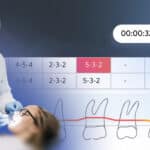

DentoAI, developed by orthodontist Amanda Cheng, DMD, MS, and backed by an AAO investment, uses AI to deliver real-time documentation and workflow efficiency for orthodontic practices.
By Alison Werner
In a typical orthodontic practice, consultations can be fast-paced, high-volume, and documentation-heavy. For Amanda Cheng, DMD, MS, that reality was the spark that led to the creation of DentoAI, a platform that uses artificial intelligence to capture detailed notes, streamline communication, and improve patient understanding—all in real time.
“We’re an ambient scribe, but beyond that, we’re an AI platform for orthodontists,” says Cheng.
Addressing the Challenges of Consult Documentation
DentoAI was built to run in the background during new patient consultations. The software listens to the interaction between the orthodontist, treatment coordinator, and patient, then generates structured clinical notes, patient-friendly treatment explanations, and referral letters—automatically and instantly.
The aim is to reduce administrative burden without sacrificing thoroughness. Rather than asking orthodontists or staff to document complex conversations manually or fill out templated checklists, DentoAI captures information in real time and formats it according to the office’s preferences.
“Notes are always the source of truth,” says Cheng. “Medico-legally, we protect the doctors.”
The platform also creates treatment summaries that are tailored to the patient’s level of understanding and available in multiple languages to ensure informed consent. She shares how, in the past, she’s had to rely on a 10-year-old child to translate complex orthodontic terms for their parent when a language-specific assistant wasn’t available. This allows patients to better grasp their diagnosis and treatment options before they leave the consult room.
Improving Patient Understanding and Case Acceptance
According to Cheng, one of DentoAI’s key strengths is its ability to improve patient comprehension at a critical decision-making point—during the initial consult. The software helps explain treatment issues that are often overlooked, especially when time is limited or the treatment coordinator is less experienced.
“Orthodontists often mention things like uneven wear, gingival health, or skeletal asymmetries during the consult, but that information doesn’t always reach the patient clearly,” she says. “Our software captures those points and presents them in language the patient can understand.”
This added clarity helps practices improve same-day case acceptance rates. Patients leave the consult with a summary they can review or share with family, and staff can use the AI-generated notes to reinforce key details. Some practices, Cheng says, have doubled their capacity for consults by cutting documentation time and increasing efficiency.
Customization for Individual Practices and OSOs/DSOs
Though powered by a blend of large language models, DentoAI is trained on orthodontic-specific terminology and workflows. The platform is HIPAA-compliant and designed to be customized by each practice. Offices can tailor documentation to their preferred clinical language, branding, referral communication styles, and more.
Cheng cites the example of a letter to a periodontist who has referred a patient. The orthodontist wants to include in the note that they have communicated to the patient the need for a 3-month perio maintenance (versus the normal 4-month) interval specific to that referring periodontist. In a busy orthodontic practice, it can be difficult to keep everyone in the loop on those details. Cheng says DentoAI can code that into the referral letter template, ensuring that it doesn’t fall through the cracks.
For group practices and OSOs/DSOs, DentoAI supports standardized documentation across locations while still allowing for doctor-level preferences. This consistency is especially valuable in practices where providers rotate between offices or take over existing cases.
“When a legacy doctor leaves, the patient’s treatment time usually extends out by another year,” Cheng says. “With standardized documentation, another orthodontist can step in and pick up where things left off.”
Support for Start-Ups and Short-Staffed Practices
For new practices or those operating with limited staff, DentoAI offers a practical solution to common resource challenges. By automatically capturing consult conversations and generating clinical notes, referral letters, and patient summaries, the platform allows treatment coordinators to manage multiple roles—or to keep pace in busy offices where two TCs may be supporting 120 patients a day across eight to 10 chairs.
Cheng notes that this flexibility is especially valuable in startup settings where the front desk, office manager, and treatment coordinator may be the same person. “The TC doesn’t have to be in the room. They can check patients in, then review the transcript and build out the financials,” she says.
Another benefit of removing manual documentation tasks, says Cheng, is the ability for staff to stay focused on the patient experience. “I want my staff to be able to maintain eye contact with the patient at all times, not typing. I want the front desk looking at Zach and saying to mom, ‘Look how much he’s grown.’ I want my staff to know every single patient and really provide that white glove service and personalized care. AI enables that.”

Designed for Orthodontics First
DentoAI was developed to meet the specific needs of orthodontic practices. Starting out, Cheng, who is board-certified in orthodontics, built the platform around the workflows, documentation standards, and terminology unique to orthodontics. The goal was to solve the challenges she faced in her own San Francisco-based orthodontic practice, from capturing detailed consult notes to improving patient understanding and referral communication. The software was designed from the ground up to align with how orthodontists work.
While it was built for orthodontists first, DentoAI is now in use across other dental specialties. The flexibility of the AI allows it to be adopted for different specialties and practice types while maintaining the core functionality that supports efficiency and accuracy.
Real-Time Insight for Orthodontists
DentoAI’s real-time capabilities extend beyond just documentation. Orthodontists can track what’s happening in consult rooms even when they’re not present, thanks to the live transcription view.
“A big problem for me was not knowing what the patient already shared with the treatment coordinator. Now, I can scroll through my phone before walking into the room and know this patient has seen eight other orthodontists or doesn’t want surgery,” Cheng says.
This allows the orthodontist to step in at the right moment with a clear understanding of the patient’s concerns, rather than relying on a rushed verbal briefing from the treatment coordinator. It also reduces duplication in communication and improves the patient experience.
Fast Implementation and Simple Interface
Cheng emphasized that ease of use was a core design goal. The platform is web-based and works on phones, tablets, and laptops—no special microphones or hardware required. Most practices can be onboarded in 10 to 15 minutes, and there’s only one button to get started.
“Our software is plug and play,” she says. “There’s no office shutdown required, no 3-day training session. We’ve had users say, ‘Just make an account, I’ll figure it out.’”
For practices with specific workflows or referral needs, DentoAI’s engineering team offers customization support, often based on the templates a practice already uses.
Focus on Privacy and Security
Security was another top priority. Cheng says the software’s encryption and data-handling protocols meet HIPAA standards, with end-to-end encryption and regular penetration testing. Both automated and manual tests are performed to ensure that the system can’t be breached.
“We’ve hired ethical hackers to try to break into it,” Cheng says. “We’ve taken every measure to make sure the data stays protected.”
Built During the AI Boom in San Francisco
DentoAI was founded in late 2023, just as generative AI tools were gaining traction across industries. Living in San Francisco, Cheng was surrounded by software engineers and hackathons. It was at one of those events that the idea for DentoAI began to take shape.
“I walked into a hackathon, and I thought, this is it,” she says. “Orthodontics is all about workflow efficiency, and AI can do that better than anything.”
She soon partnered with Arun Saigal, an MIT-trained engineer with experience scaling software to millions of users. The two co-founded DentoAI with a team of engineers focused on building a simple, accurate, and customizable tool for orthodontists.
Endorsement from the AAO
In October 2025, DentoAI received a strategic investment from the American Association of Orthodontists (AAO) through its Innovation & Transformation Fund. The fund, created in 2019, supports startups and initiatives that aim to bring innovation to the specialty.
“For me, this is a badge of honor,” says Cheng, who now works full time on DentoAI as CEO. “The AAO is one of the most respected orthodontic organizations in the world. Having that vote of confidence is really important to me.”
What’s Next
By the end of 2025, DentoAI is expected to complete integrations with major practice management software platforms. The company is also developing features to support follow-up workflows, including AI-assisted recall and case follow-up calls based on consult notes.
Cheng’s long-term goal is to create a fully integrated system that handles documentation, communication, and follow-up from a single interface.
“We want orthodontists to click once, and AI takes care of the rest,” she says. “We want doctors to get time back because that is one asset we can never recapture.” OP
Opening Image: ID 322680569 © Alexandersikov | Dreamstime.com. Article Photos courtesy of DentoAI.
Alison Werner is chief editor of Orthodontic Products.