
Learn how to avoid wasting time, money, and effort when remodeling or constructing a new office while improving the patient and staff experience.
By Greg Thompson
Planning a practice remodel or starting from scratch with new construction can be an overwhelming prospect for orthodontists who are looking to expand. Time, money, and effort are precious commodities and wasting all three can happen all too easily. The best way to avoid this and future proof your investment: Once you’ve set your big project goals, drill down on the details.
Trends shaping the space
Stephanie Woeste, director of Dental Marketing for Ohio-based Midmark Corp, knows the challenges of an office remodel or new construction and has tracked the trends. “The most notable impact on clinical space design in recent years is certainly the COVID-19 pandemic, with the challenge of aerosol containment,” she says. “In an orthodontic practice, this is perhaps a bigger issue to solve than in general practice or other specialist practices because of the common open bay design.”
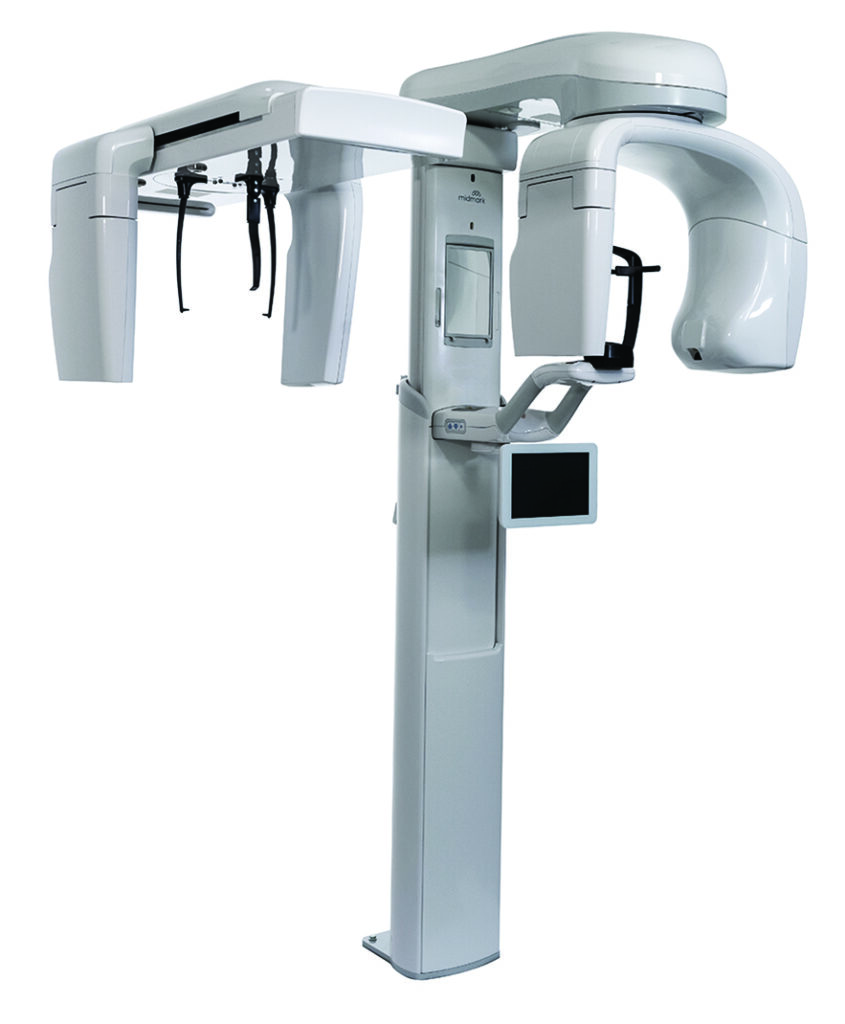
Aside from the pandemic, advances in technology may require special design for sizable equipment or radiation compliance. These concerns inevitably lead to bigger conversations about design and Woeste points out that it all comes back to the central question: What is the patient experience and what is the practice staff’s experience?
The stakes are high because a properly redesigned space that improves the patient experience can increase retention and attract new patients. “By improving safety and workflow, you could also increase employee satisfaction leading to better staff retention rates,” Woeste explains. “Before you design, identify your objectives. We recommend focusing on four things: ergonomics, safety, workflow, and aesthetics. Keep those principles in mind and make the space your own.”
Workflow efficiencies
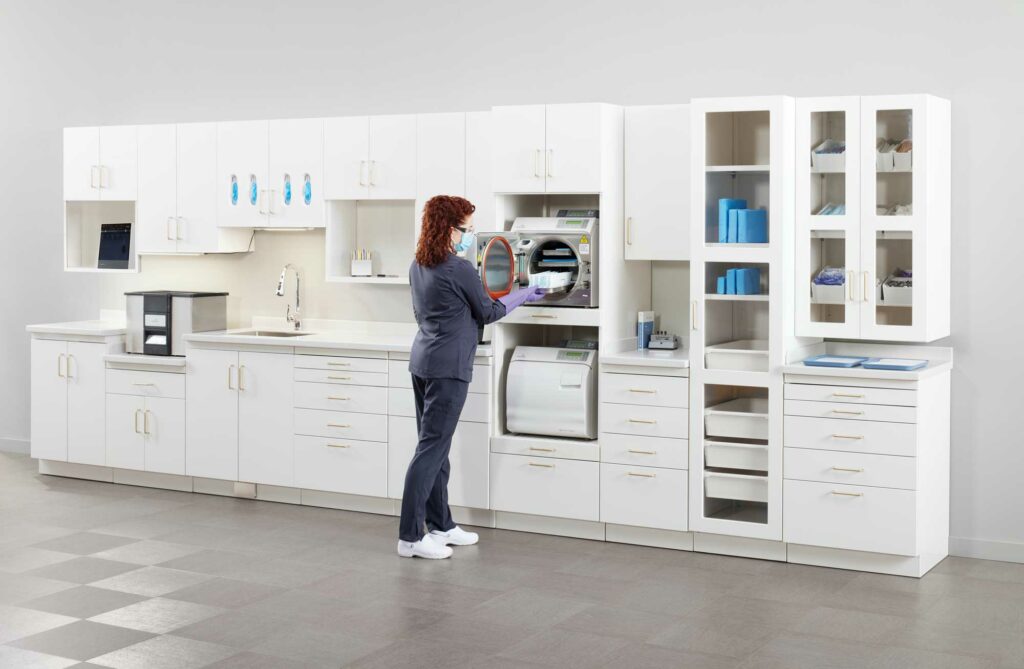
Design professionals frequently come back to the “workflow” theme because it encompasses so much of the practice framework. Running an orthodontic practice is not easy and stress is often caused by workflow inefficiencies. Knowing when it’s time to change is half the battle.
Woeste urges providers to consider the space. For example, were “temporary” dividers put up because of the pandemic? Are these dividers still there in the “open bay floor plan” and making the space uncomfortably tight? While the safety concerns are valid, perhaps it’s time to introduce a permanent solution that provides adequate treatment space.
“Is your workflow efficient for preparing for new patients, treating patients, and then cleaning and disinfecting for the next?” Woeste asks. “Is everything consistently organized? Is your sterilization centralized? Do you have enough equipment, instruments, and supplies on hand to manage a full day? These are a few questions to ask as you consider designing for a healthier environment.”
Future proofing your investment and your redesigned space
Before taking the plunge and redesigning any clinical space, orthodontists must understand and identify key opportunities for improvement. These areas grow naturally from the four objectives, while drilling down on the details can generate new questions. For example: Does the limited space adequately support current and future equipment investments? Does it adequately support current and future procedures? Does the limited space adequately support current and future staff numbers and patient volume? Redesign is fine, but expansion may be necessary.
Additional areas to identify include chokepoints or bottlenecks, inefficient foot paths, and just plain “old and tired” elements that need to go. “A good understanding of your current condition will help you determine the scope and focus of your redesign,” Woeste muses. “It may not have to be as extensive as you think. Or in fairness, you may need to do a little more than you think.”
Fresh eyes can help you get your remodel right
Since the consequences of getting it wrong are costly, it’s a good idea to bring in help. Being blind to the flaws of a given practice is common and fresh eyes can help to get the remodel done right the first time.
Trade show attendees at the recently-completed Yankee Dental Congress and Chicago Dental Society Midwinter Meeting benefitted from Midmark’s in-booth expertise, and consultations at Henry Schein’s THRIVELIVE dental conferences in May will also provide expert advice. Dentists and orthodontists who can’t attend can also meet with Midmark 3D layout designers to see their floor plan, equipment selections, and finishes come to life in a 3D rendering.
Gather information from those with experience
Consultants can make the process a lot smoother, but information gathering should not be limited to conversations with professionals. Woeste believes the best approach is “to ask and observe” and even host a few lunch and learns with team members to gather candid feedback about daily experiences. “Survey your patients about their visit experience,” Woeste says. “Leverage your business partners. Your distributor and other vendors may offer workflow audits that can provide an independent perspective.”
Finally, consider trends within your practice. Often referred to as the Zoom Boom, orthodontic practices are seeing higher levels of clear aligner interest from adults due to increased video conferencing.
“If your practice is designed with younger patients in mind, consider how adult patients perceive the experience,” Woeste adds. “Differentiate by appealing to a shifting demographic. Within the treatment area, create some separation with a more exclusive feel—like patient chairs with heat and massage—yes, they’re available. It will certainly create word-of-mouth and social media buzz that could boost a new-patient marketing strategy. Finally, let your personality or brand shine through. You should be able to measure your investment and see the return.” OP
Greg Thompson is a contributing writer for Orthodontic Products.