Flat production and steady case starts mask a more complex picture—where overhead, staffing, and efficiency will determine who thrives next.
By Roger P. Levin, DDS
Stability was the theme in 2025—a year of little change in orthodontic practice performance. After several years of challenging performance due to the pandemic followed by a rebound year in 2024, orthodontic practices responding to the Orthodontic Products/Levin Group Annual Practice Survey reported slight declines in 2025 production but relative stability overall.
Survey Demographics
The data for this year’s Orthodontic Products/Levin Group Annual Practice Survey was collected between February 25 and March 6, 2026, from a random sample of practicing orthodontists who were asked to consider their practice results for the full 2025 calendar year.
Participation was heavily weighted toward orthodontists who are in private practice. 96% of the respondents are in some form of private practice and 4% work for a DSO/OSO organization. The average age of respondents is 56.4 years, with 71% identifying as male, 27% as female, and 2% preferring not to answer.
Among respondents, 60% reported that they are in solo practice, 27% say they practice with one other orthodontist, and 12% are in practice with 3 or more orthodontists. Orthodontics is a volume-based business where one doctor can manage a large patient load, creating the opportunity for high revenue and profit. Therefore, it isn’t surprising that the vast majority, almost 9 out of 10 orthodontists, practice alone or with one associate or partner.
Production Trends
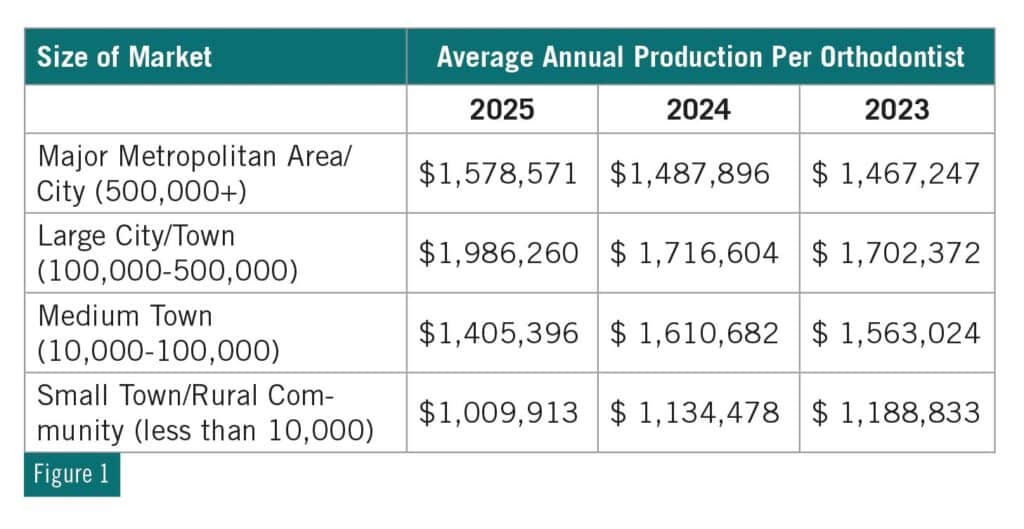
The average production per orthodontist in our survey was $1,570,806. This number represents a 1.1% decrease from 2024. Although things are down slightly nationwide, some markets showed growth.
More insight can be gained by viewing production statistics broken out by market size.
Note that in Figure 1, the largest revenue was in the large city/town category. Even more interesting is the significantly lower production reported by orthodontists practicing in a small town/rural community (population less than 10,000). Those orthodontists had 33% lower revenue than the other larger markets.
What About the Future?
The answer leaves no room for doubt. 90% of orthodontists are optimistic about the future and expect to see an increase in production in the coming year of 2026. And a whopping 94% of the respondents stated that they are confident they will maintain a successful orthodontic practice over the next five years. Obviously, these answers are not based on actual numbers (most of 2026 hasn’t happened yet) but reflect the general feeling among orthodontists that the current year will be good. (Only 10% expected to decline in production in 2026.) And that’s great.
But remember that, as the saying goes, hope is not a strategy. If practices fail to implement efficient systems and properly train their teams, maintain strong referral marketing, and elevate treatment coordinator performance, that optimism may be misplaced.
What Happened to Orthodontic Practice Profit in 2025?
Here is the data:
51% reported an increase in profit in 2025
31% reported decreased profit
18% were flat (no growth, no decline)
Based on our long-term observation and analysis of the orthodontic profession, Levin Group has developed the perspective that orthodontic practices will fragment into four distinct buckets. Fifteen years ago, almost all orthodontic practices increased in profitability every year. We don’t believe that will be the case moving forward. In the future, the top 25% of practices will be phenomenally successful and increase practice income by at least 15% annually. The next 25% group will do well and increase practice income by up to 15%. This “top half” will be the “practice of choice” in their area and can expect to sustain practice growth for the doctor’s career. The bottom half could be facing significant challenges in the future. Those practices with flat or declining practice income will struggle to remain competitive and get the referrals and new patient starts necessary for practice success. This year’s profit data strongly supports Levin Group’s perspective.
And Then There’s the Impact of Overhead on Profit
The average orthodontic practice overhead percentage this year was 56.5%, which means that the average profit was 43.5% of revenue. Those numbers are a little bit worse than the previous year—overhead was slightly higher and profit was slightly lower. Just over half the practices (51.4%), reported higher overhead in 2025 compared to 2024. If you’ve been reading this survey analysis article over the years, you may recall that higher overhead is a relatively recent trend in orthodontics, but one that now seems to be sticking around.
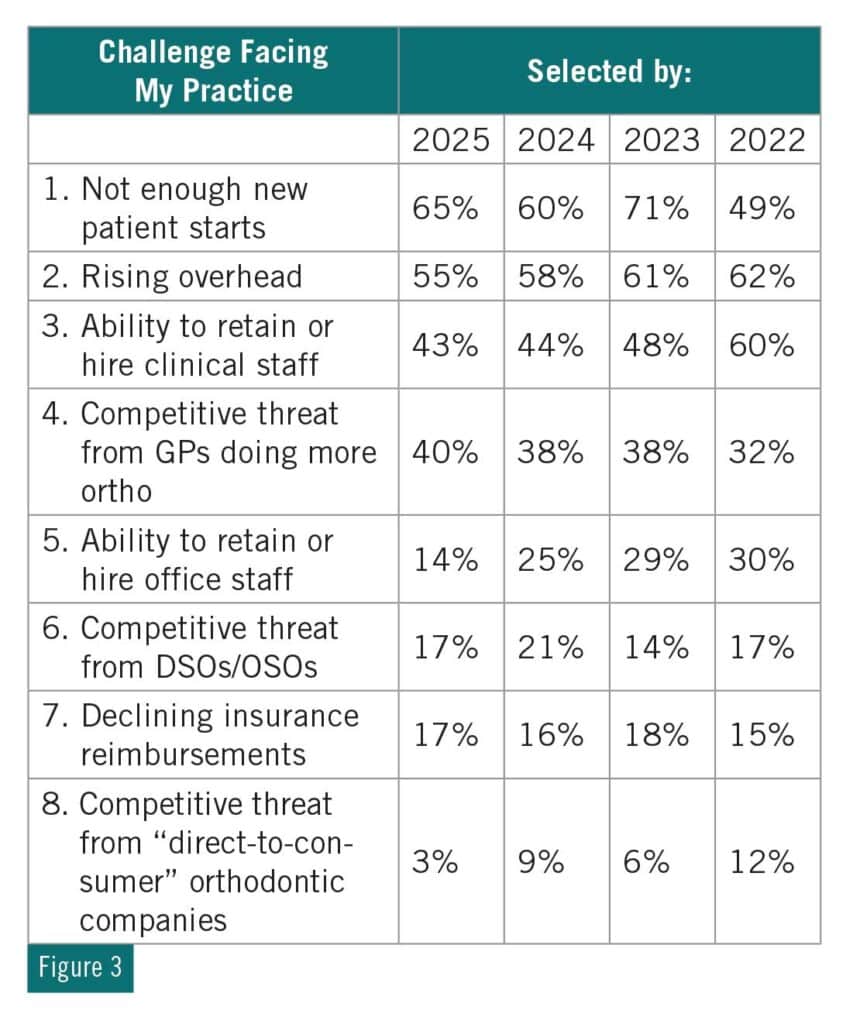
Only 10% of orthodontists reported lower total overhead in 2025, so it is no surprise that, when asked to rank their biggest challenges right now, overhead was listed as the second biggest challenge.
Check our podcast interview with Dr Roger Levin where he breaks down the survey findings and provides actionable tips to help you have the best 2026 possible.
The 2025 results show a difference between total patient volume and new patient volume. Total patient volume improved, with 74% reporting the same or higher levels—up 10 percentage points from 2024—while new patient volume remained relatively stable at 65% compared to 63% last year.
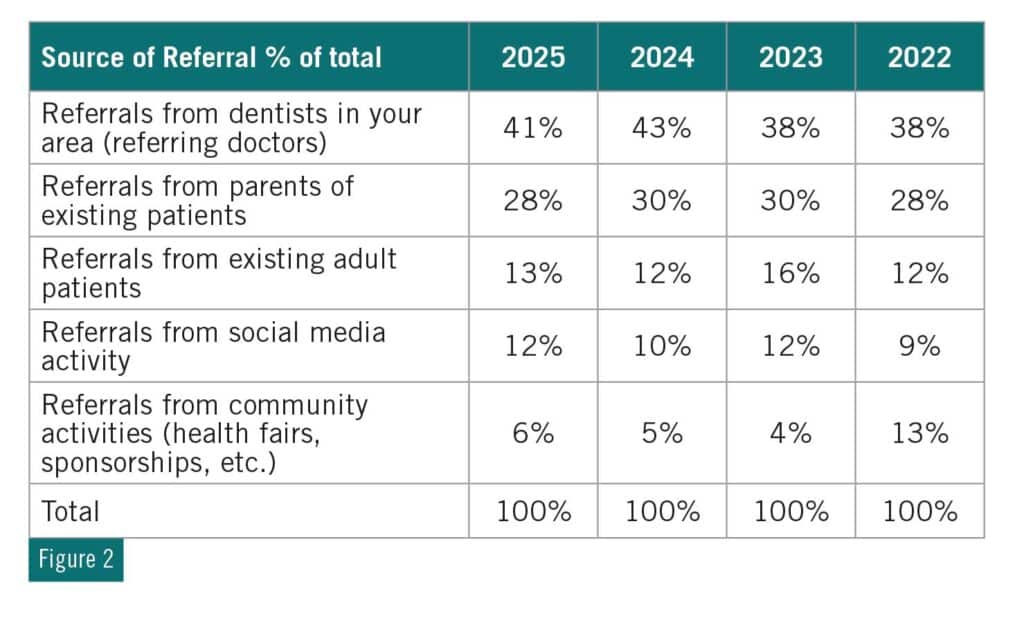
We also evaluated referral sources, which have a direct effect on patient value. When asked to identify the source of their new patients, orthodontists responded as follows:
Four years’ worth of data demonstrate the general stability in patient acquisition sources across our profession, although it is notable that referrals from general dentists and referrals from parents of existing patients each dropped from 2024.
The obvious observation is that GPs are still the largest source of referrals to orthodontic practices, despite the fact that at times they may also be providing aligner services. We know from our general practice surveys and observation of our clients that most general dentists are not doing a lot of aligners in their practice and still refer out over $6 billion in orthodontic revenue every year.
What Do Orthodontists See as the Biggest Challenge Right Now?
The top challenge reported in our survey is “not enough new patient starts.” A logical choice given that more new patient starts means more revenue and collections and higher practicing income, where everyone would be happy. Not having enough new patient starts can be offset by an excellent referral marketing program that focuses on five focus areas—patients, parents, referring doctors, social media, and the community. In our experience, the most successful practices are reaching out in three or more of these areas, one of which includes referring doctors.
The challenge posed by rising overhead is basic economics. We have experienced a significant increase in the cost of orthodontic staff members as well as inflation. The average overhead increase reported by orthodontists in this survey was 3.2%. This means that “orthodontic inflation” (the increase in costs needed to operate an ortho practice) is higher than the current U.S. inflation rate at the time of writing this article.1 Orthodontists are swimming upstream as regards their profitability. Practice owners and office managers must analyze overhead looking for opportunities to reduce costs to the practice.
And it is interesting to see the dramatic reduction in concern over competitive threats from direct-to-consumer ortho companies. With the departure of Smile Direct Club in 2023, there are very few companies in that space now.
What Type of Cases Are Being Done and What Are the Fees?
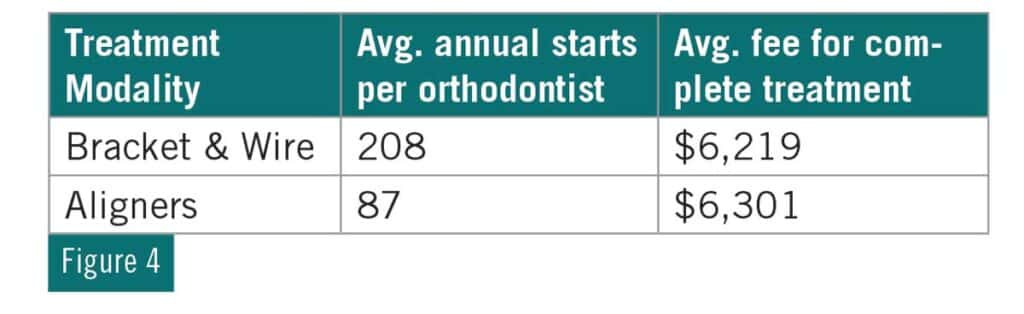
The average annual starts in 2025 per orthodontist for bracket and wire treatment was 208. For clear aligners it was 87. This total average start number of 295 is slightly higher than last year—a positive sign of stability.
The average bracket and wire fee, up 1.6% from 2024 was $6,219. The average fee for clear aligners was up 1.1% from 2024 at $6,301. Neither of these changes is statistically significant. Fees barely changed and did not offset the higher overhead described above.
How Long Are Intervals for Office Visits Today?
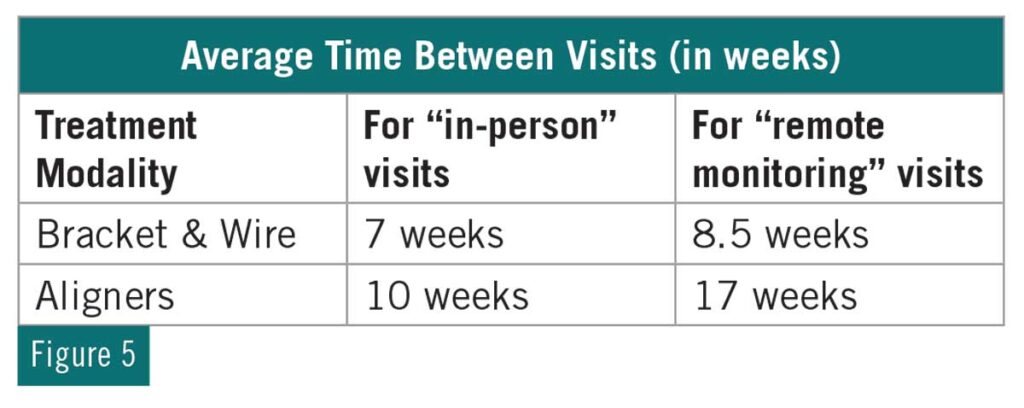
It is generally recognized that the interval for patient visits is going to expand. The only question is when, by how much. Respondents to this survey see aligner patients much less frequently than bracket and wire. As you’ll see from Figure 5, the average bracket and wire in-person visit interval is seven weeks and for aligners it is 10 weeks. It is notable that we also had responses as high as 25 weeks in between aligner visits.
We also collected data on the intervals for practices using remote monitoring, which is growing in popularity. Bracket and wire patients who are remote monitored are coming in at 8.5 weeks on average and aligner patients averaged 17 weeks. This is a strong economic case for adding remote monitoring to a practiceif you have the marketing strategies in place to fill the excess chair time that remote monitoring creates.
Speaking of Remote Monitoring and Teledentistry…
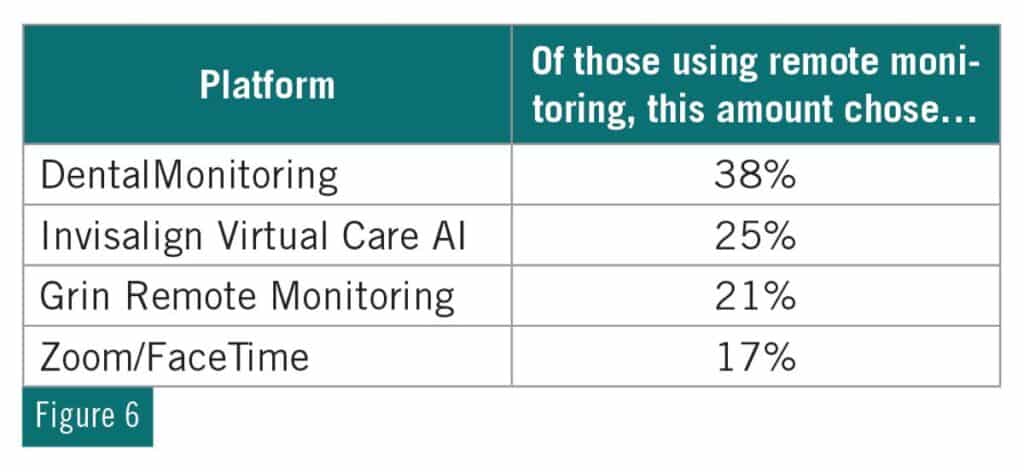
Thirty percent of orthodontists surveyed are using teledentistry or remote monitoring in their practice now. They are primarily using it for ortho checks (75%), retainer checks (55%), and emergencies (30%). These numbers represent a very significant increase in adoption over the previous survey. And interestingly, no orthodontists reported using a teledentistry tool for new patient consults or exams. This has been steadily decreasing since the pandemic, and this survey suggests that all new patient interaction is conducted in-person.
For those using some form of teledentistry/remote monitoring they reported using these platforms.
And Now for Staffing
I was asked in a seminar this week about the state of dental staffing. My response was crisp and clear. We have a crisis and it will last at least 10 years. This crisis started in the pandemic with loss of staff members not returning to orthodontics and an increasing number of people who want to work at least part- or full-time from home, which is not conducive to jobs in orthodontic practices.
The survey indicated that more than 74% of orthodontists believe there is a shortage of orthodontic staff available for hire. This is incredibly high and has not retreated at all from last year’s survey. 57% of orthodontic practices are currently seeking to hire a staff member right now and 57% of practices have at least one vacant position also seeking to hire right now. Not including doctor compensation, 81% of orthodontic practices are paying more total compensation (per individual job position) now than in 2023. This trend of escalating staffing costs continues and has not been offset yet by adding new technologies (such as artificial intelligence) to reduce labor costs.
Further demonstrating this difficult situation, staff compensation was reported to be 6.3% higher this year. And not one practice reported lowering compensation this year.
When asked, “What are you doing to address the current staffing challenges?” the responses were as follows:
Increasing base compensation for staff (selected by 56%)
Providing more bonuses for staff (selected by 29%)
Offering more/better employee benefits (selected by 15%)
Adding technology for productivity enhancement (automated reminders, etc.) (selected by 46%)
Reducing office hours (selected by 8%)
Finally, the Treatment Coordinator…
This year we asked how many practices had full-time TC’s. Of those that responded, 85% reported that they did. But that means 15% do not, and that’s worth discussing. Treatment Coordinators can have a huge positive impact on practice production and patient satisfaction. Starts are the heartbeat of an orthodontic practice. And in a world where some practices may see fewer referrals, one way to offset that is by increasing the percentage of new patients who start treatment. A TC with high-level sales skills can create value for your practice in every conversation they have with a new patient.
Recommendations for 2026
I always like to include some practical recommendations for orthodontic practices to move to the next level of success. Here are three things to focus on in 2026 if you want to be in the top 25% or 50%.
Set an increased production goal every year: Setting production goals is now more important for different reasons than in the past. Overhead is rising and exceeds the broader economy’s inflation rate. You want to ensure that your production increase outpaces your overhead increase. If your overhead is growing at a higher percentage rate than your production, you will be losing income. A 2% drop in income for over 3 to 5 years is significant.
Keep referral marketing strong and consistent: Orthodontic practices need new patients. They are the heartbeat of the practice. Although starts are critically important and we do, of course, suggest you focus on having an excellent TC process, you have to have the new patients for the TC to have consults. By keeping a steady stream of referrals from multiple sources, you protect yourself as competition grows and shifts.
Control your overhead: Overhead is now a more significant factor than in the past. Staffing has significant challenges and you want to retain excellent staff members as long as possible. (That is an article for a different day.) However, the cost of staffing along with normal inflation has started to impact profitability and even retirement ages of orthodontists. In order to keep overhead under control, you can use standardized business strategies such as bidding out your largest expenses every year, asking sales representatives to help you reduce costs through new creative programs and ideas, using bonuses for staff compensation rather than simply increasing base salaries (beyond a cost of living adjustment), joining buying groups and other strategies. Practices that are diligent about analyzing overhead on a monthly and quarterly basis can expect to increase profitability, or at least not see an erosion of profitability going forward.
Overall, we felt that this year’s survey results reflected a stable orthodontic specialty and an opportunity for most orthodontic practices to take the steps to do extremely well. We hope as you read this you have seen where your opportunities may lie, and please pay special attention to the challenges section to determine which ones are affecting you and what specific actions to take.
As always, we wish you the best of luck and success going forward. OP
Reference:
U.S. Bureau of Labor Statistics, referenced on March 15, 2026, https://www.bls.gov/cpi/
Roger P. Levin, DDS, is the CEO and founder of Levin Group, a leading orthodontic consulting firm that has worked with over 30,000 doctors to increase production. A recognized expert on ortho practice management and marketing, he has written 67 books and over 4,000 articles and regularly presents seminars in the U.S. and around the world. In 2025 Levin received the Fauchard Gold Medal from The Pierre Fauchard Academy for his contribution to dental practice management. To contact Levin or to join the 40,000 dental professionals who receive his Practice Production Tip of the Day, visit levingroup.com or email [email protected]