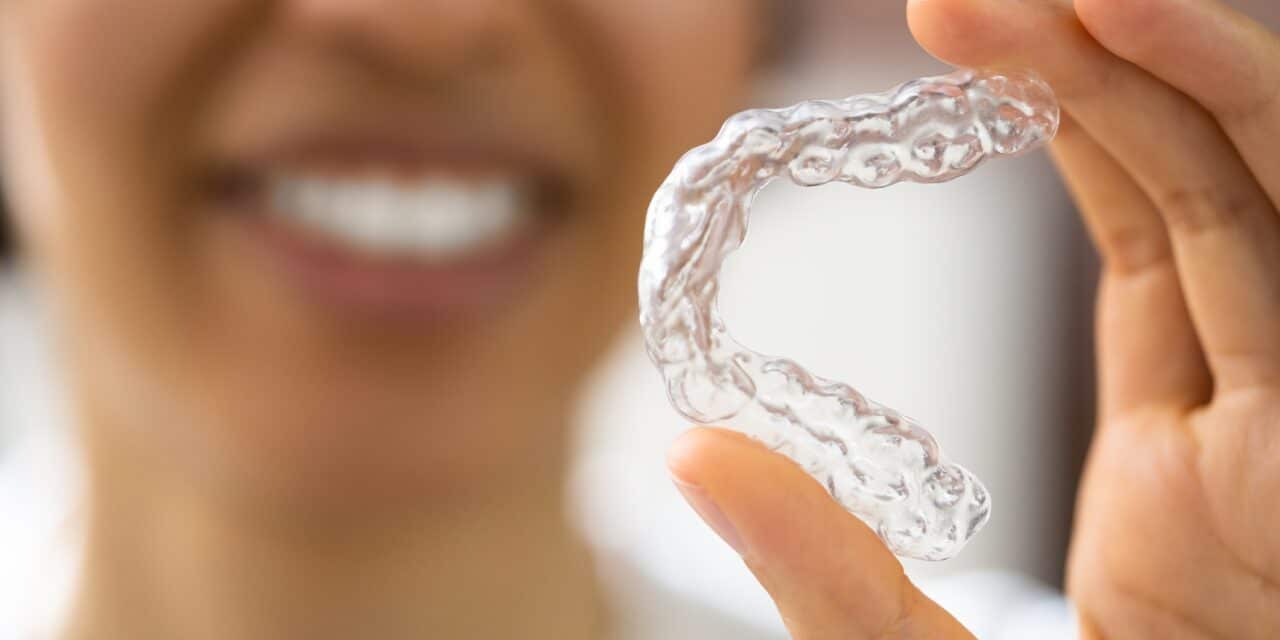
While competitors view direct printing as a future concept, LuxCreo says its new partnership validates that the technology is ready for mass adoption now.
BY ALISON WERNER
Last fall’s strategic investment by Angel Aligner in direct 3D printing company LuxCreo marks a significant milestone for the clear aligner market. The partnership, aimed at co-developing next-generation materials, signals that direct-printed aligners (DPAs) are transitioning from a niche technology for early adopters into a mainstream solution poised to challenge traditional thermoforming.
For Mike Yang, PhD, co-founder and CEO of LuxCreo, the collaboration is more than a vote of confidence; it’s an inflection point for the industry. “This is a huge milestone. It marked the transition of the direct-printed aligner from the early adopter phase…into mass adoption,” he says. “It’s becoming mainstream.”
A SHIFT TOWARD MASS ADOPTION
While major players like Invisalign have publicly stated that DPAs are the future, they have often framed that future as being five years away. Yang argues the partnership with Angel Aligner, one of the fastest-growing aligner brands globally, will drastically shorten that timeline. The collaboration provides LuxCreo with extensive clinical data that will “vastly accelerate” material innovation and platform development.
“With Angel, this could happen much, much sooner,” Yang says. “The technology is ready.”
LuxCreo received the world’s first FDA Class II 510(k) clearance for a direct-printed aligner system in May 2022. Yang describes LuxCreo’s origins as a “typical startup story,” noting that the company was founded in a Palo Alto garage where the team began researching direct clear aligner resins in 2019. The Angel Aligner partnership validates this work and provides the resources to scale production and gather the clinical evidence needed for wider adoption.
A GENERATIONAL SHIFT IN MATERIAL SCIENCE
At the core of the direct-printing revolution is a fundamental change in materials. Unlike the thermoformed plastics used for decades, DPAs are fabricated from thermosetting photopolymer resins. This distinction, Yang explains, represents a “generation shift” in how aligners perform.
“If you were to go back to the technicals about this, you go from a thermoforming material to a thermosetting material with digital precision and shape memory, and that is fundamental,” he says.
Traditional thermoformed plastics like PET-G or TPU are shaped with heat and pressure, but they lack shape memory and begin to deform almost immediately under intraoral stress. “The moment you put it in, your aligner is degrading,” Yang notes. This rapid force decay is a known limitation that can compromise treatment predictability.
In contrast, LuxCreo’s direct-printed aligners are made with ActiveMemory Polymer, a thermosetting resin with a dual-mechanism molecular architecture.¹ A hard segment maintains the aligner’s stiffness and ensures consistent force delivery at mouth temperature (37°C), while a soft segment allows for reversible deformation under load. This gives the material a unique shape memory property. When immersed in hot water (above 60°C), the aligner fully restores its original geometry and force profile.
“It’s almost like you get a new aligner every day,” says Yang. “But just getting the right shape is not enough. You’ve got to have the right shape and the right force. That’s what defines a new aligner.”
PRECISION, CONTROL, AND PREDICTABILITY
The direct 3D printing process, which builds aligners layer by layer, unlocks a level of precision that is impossible with thermoforming. Because resin is added incrementally, clinicians can design aligners with variable thickness—thicker in areas requiring more force and thinner at the gingival margin for patient comfort.
This precision translates to improved accuracy and better clinical outcomes. Yang cites internal studies showing LuxCreo’s DPAs achieve over 96% dimensional accuracy at a 200-micron threshold, compared to 81% for typical thermoformed aligners. This superior fit means the aligner hugs the teeth more effectively, improving force application and reducing the need for attachments.
The shape memory of ActiveMemory Polymer also introduces a self-correcting mechanism. While thermoformed aligners drift from the treatment plan as they deform, DPAs can be reset to their original state. “Put it in hot water. You know where home is. You could actually bring it back,” Yang says. “Every step is self-correcting.” This enhances predictability and helps reduce the number of mid-course corrections and refinements.
THE IN-OFFICE ECOSYSTEM
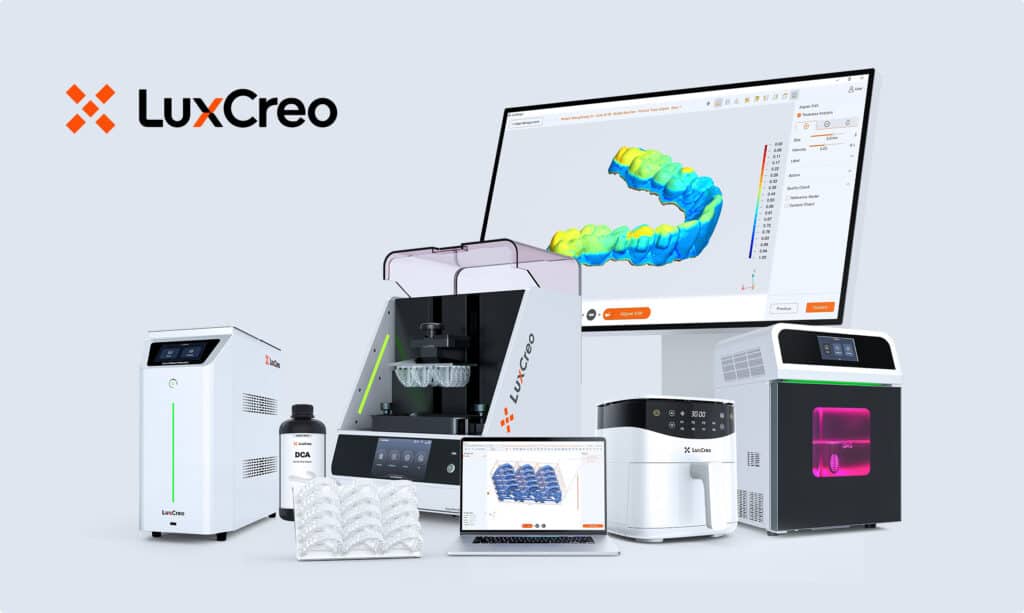
To bring this technology into the private practice, LuxCreo has developed a fully integrated, chairside solution designed for ease of use. The iLux Pro Dental (ILPD) solution includes a printer, an automated two-stage washer, a thermal dryer, and a curing box, all designed to fit on a standard four-foot table.
Yang emphasizes that the system is built for automation and consistency, removing the technical burden from the clinical team. “You could grab anyone, and with just a half a day of training, they will be able to make the aligner consistently,” he says. The company provides the hardware, software, and materials as a single solution, taking full responsibility for the output. “We approach the market by saying that, look, if anything goes wrong, that’s our fault.”
The post-processing steps are also carefully controlled for safety and efficacy. An automated washing cycle removes uncured resin, and a high-temperature thermal drying stage evaporates residual solvents and volatile compounds, improving biocompatibility.
A PATH FOR EVERY PRACTICE
While the in-office system offers orthodontists complete control, Yang acknowledges that not every practice is ready to bring manufacturing chairside. For those doctors, LuxCreo offers a path to experience the technology without the initial investment.
He recommends two approaches. First, practices can work with a trusted local dental lab that has adopted the LuxCreo platform. Second, they can submit cases directly through LuxCreo’s online cloud service, which offers a workflow similar to that of major aligner brands, including AI-assisted setup and treatment planning support from orthodontists.
Yang advises clinicians to start exploring the technology now. “Allocate about 20% to 30% of your cases to try it out,” he suggests, comparing the current moment to the transition from CDs to music streaming. “This is a future that you don’t want to miss.”
As major industry players like Angel Aligner invest in DPA technology, its evolution is set to accelerate. For orthodontists, this shift promises not just a new manufacturing method but a more predictable, precise, and controllable way to deliver clear aligner therapy. OP
Reference
- What are Direct-Printed Aligners? LuxCreo. Published December 29, 2025. Accessed January 2, 2026. https://luxcreo.com/what-are-direct-printed-aligners%EF%BC%9F/
Opening photo: ID 247739661 © Andrey Popov | Dreamstime.com
Alison Werner is chief editor of Orthodontic Products.