
As AI and automation reshape orthodontic workflows, software platforms must adapt to accommodate two distinct clinical styles without forcing either to compromise.
By Alison Werner
The digital revolution in orthodontics has brought a wave of automation—and now, artificial intelligence—to the specialty, promising unprecedented efficiency. However, the rise of these technologies has also highlighted a fundamental psychological and operational divide in how clinicians approach treatment planning. On one side of the spectrum is the clinician who demands granular control over every tooth movement; on the other is the practitioner who simply wants a predictable, expert-validated result without the hassle of micromanagement.
As software platforms evolve, developers are realizing that to truly serve the orthodontic specialty, technology must seamlessly accommodate both clinical styles.
Defining the Two Profiles
Evan Tsai, who works in research and development for Ormco’s StageRx platform, categorizes these two distinct profiles as the “tinkerer” and the “automationist.”
For the tinkerer, orthodontic planning is a highly customized, hands-on process. These doctors want to sequence specific movements, group difficult mechanics with simpler ones, and meticulously plan anchorage to mitigate side effects. In the past, this required typing out lengthy, complex instructions to CAD designers—a process fraught with communication breakdowns. Today, tinkerers want digital tools that allow them to build and save their own modular treatment protocols.
On the other end of the spectrum is the automationist. These clinicians value time and efficiency above all else. They are less interested in the minutiae of staging and more focused on the final outcome and practice throughput.
“Basically, doctors say I don’t have time to do all of [this tinkering], and I just want to follow your best program,” Tsai says. For the automationist, the ideal software provides a library of preset, expert-validated protocols that can be applied to a case with a single click.
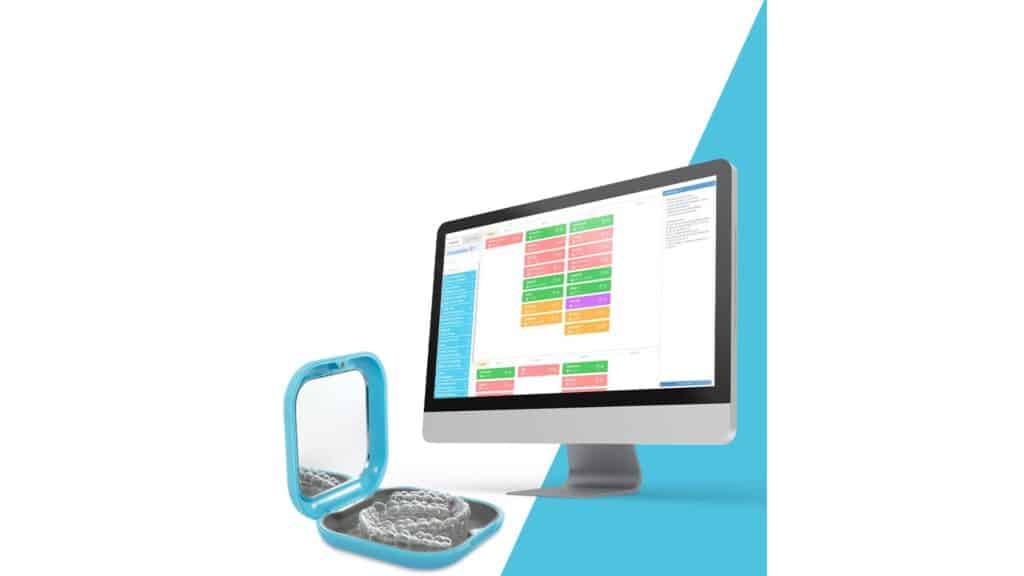
of building blocks to plan aligner cases.
Customization Through Standardization
To bridge the gap between these two operational styles, developers have had to rethink how doctors interact with clear aligner treatment planning software. The solution lies in a concept Tsai refers to as “customization through standardization.”
In StageRx within Ormco’s Spark Approver platform, this is achieved through a visual, color-coded system of building blocks. Rather than typing out open-ended instructions, orthodontists use standardized commands categorized by the three planes of space: transverse, vertical, and sagittal.
Tsai compares the design philosophy to building with Lego bricks. “Every Lego piece is standardized, but when you have these standardized pieces, you can create anything you want,” he says.
This standardized language allows tinkerers to construct highly specific, personalized protocols. Simultaneously, it allows automationists to drag and drop pre-built protocols designed by industry experts, knowing the AI and the designers will perfectly understand the standardized commands.
A Clinician’s Journey Across the Spectrum
For many orthodontists, the line between tinkerer and automationist is not static. Nadia Nizam, DDS, MCID, FRCD (C), a Canadian orthodontist who uses StageRx for all her Spark aligner cases, perfectly illustrates how a clinician can navigate this spectrum.
When Nizam first adopted the platform, she leaned heavily into the automationist approach. Acknowledging that every orthodontist needs a foundational “belief system” to dictate how teeth should move from point A to point B, she opted to use the platform’s Master CoIP protocols to plan her Spark aligner cases. These expert presets provided a reliable baseline, allowing her to utilize a proven system without having to build it from scratch.
Over time, however, Nizam evolved into a tinkerer. As she evaluated her cases month by month, she began modifying the expert presets to better match her specific clinical preferences. She tweaked the standardized blocks, saved her adjustments, and eventually built a 100% customized protocol library of her own.
“It’s a recipe card that has all the directions that the designer needs to follow what’s in your brain,” Nizam says.
Eliminating Digital Homework
Whether a doctor operates as a tinkerer or an automationist, the ultimate goal of modern planning software is to reduce the administrative burden known as “digital homework.”
By relying entirely on her custom StageRx protocols, Nizam has eliminated the need to type out instructions or engage in endless back-and-forth communication with designers. Because her exact staging preferences are baked into the modular blocks, the cases she receives back are exactly what she envisioned.
“Before, I was spending at least 10 minutes or so on each arch… it was taking me a minimum of 30 minutes if I was being fast about it,” Nizam says. Now, because the designer has already followed her exact recipe, she can review and approve a case in a matter of seconds.
This standardized approach also removes the burden from practice staff. Nizam’s team now handles all case submissions with near-zero errors.
The Future of Clinical Control
As automation continues to advance, a lingering fear among some specialists is that AI will eventually replace the doctor’s clinical judgment. However, by designing systems that cater to both the tinkerer and the automationist, software developers are proving that efficiency does not have to come at the expense of clinical control.
“We want automation to be the co-pilot for the doctor, but the doctor should still be driving the thinking and should still be doing the treatment planning,” Tsai says. “We don’t want automation to take over the doctors.” OP
Opening image: ID 48960979 © Wavebreakmedia Ltd | Dreamstime.com; article image: Ormco
Alison Werner is chief editor of Orthodontic Products.