Dr Kent Morris shares how the addition of hooks to the 3D-printed device has opened up new treatment options for Class III cases and streamlined his Phase I workflow.
By Alison Werner
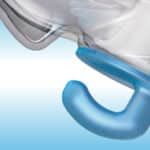
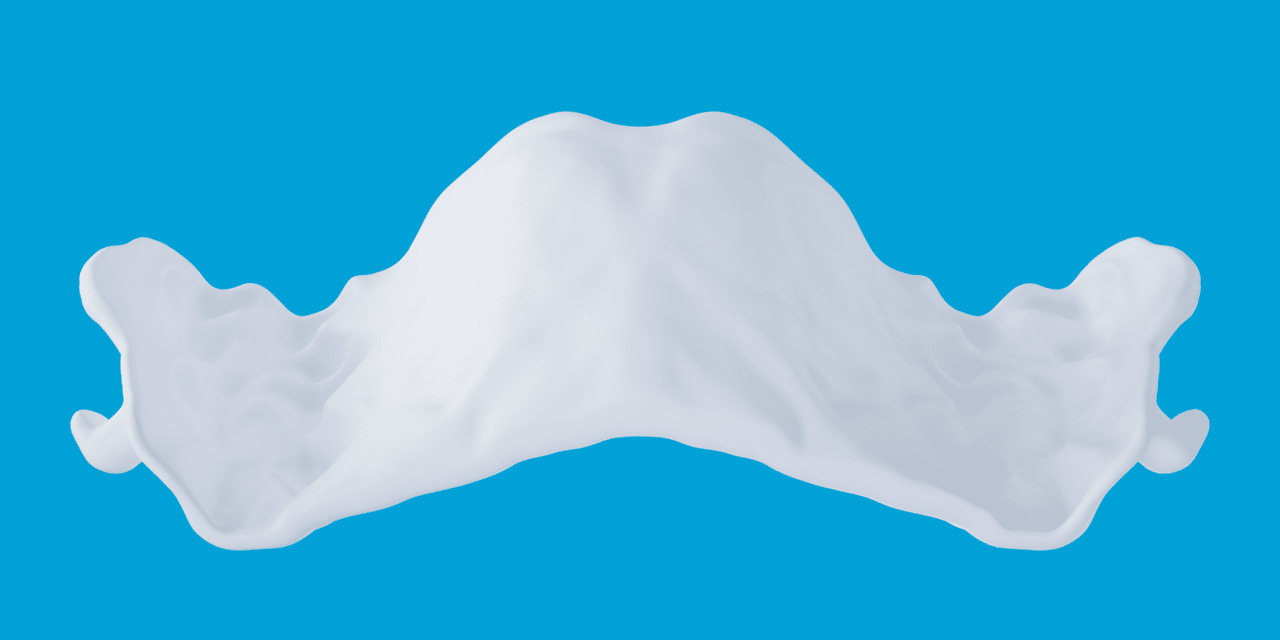
As digital workflows and 3D printing continue to reshape orthodontic treatment, the tools available for early intervention are evolving rapidly. Align Technology recently expanded its early treatment portfolio with an update to the Invisalign Palatal Expander (IPE) System. The direct 3D-printed nylon device, which is designed to follow the curvature of the palate and cover three posterior teeth, now features forward- and backward-facing integrated hooks. This addition allows orthodontists to attach adjunctive mechanics, such as elastics or a protraction facemask, directly to the appliance.
For Kent Morris, DMD, a single-practice orthodontist based in Cincinnati, Ohio, the IPE has become a cornerstone of his Phase I treatment plans over the last few years. Having completed nearly 600 cases with the appliance, Morris was an early adopter who quickly recognized its potential.
“I was already doing the IPE part,” Morris says. “The hooks just give me another piece of the puzzle.”


The Invisalign Palatal Expander (IPE) is available with backward and forward facing hooks.
A New Dimension for Class III Malocclusions
The most significant shift Morris has experienced with the addition of the hooks is the ability to treat a broader range of complex cases, particularly skeletal Class III malocclusions, with a single integrated system. Previously, treating a Class III patient might have required a bonded expander, manually built-in hooks, and eventually a 2×4 appliance to achieve the desired movement.
Today, the integrated hooks on the IPE allow Morris to utilize Class III elastics from the upper arch to the lower arch—a mechanic he previously lacked the power to execute seamlessly with a removable palatal expander. He also utilizes the hooks to attach traditional reverse-pull facemasks.
Morris points to the “pseudo Class III” patient as a prime example of where the updated IPE shines. In these cases, the patient bites down into a Class III occlusion, but when the mandible is relaxed, they drop into an edge-to-edge bite.
Historically, Morris would have relied on a bonded expander to jump the bite. Now, the process is entirely aligner-driven. He starts the patient in lower Invisalign aligners with integrated buttons right out of the gate. Simultaneously, he utilizes the IPE on the upper arch to achieve expansion.
“A lot of times, that’s almost enough just to deprogram them,” Morris says. When he adds Class III elastics to the setup, it creates what he describes as “a seamless experience, especially for younger children.”
This approach also eliminates a major clinical headache associated with traditional brackets in Class III cases. When a patient with a Class III tendency bites down and drops back, they often break lower anterior brackets, forcing the orthodontist to prop the bite open. The removable nature of the IPE allows the patient to eat and function normally without the risk of constantly breaking hardware, providing the clinician with significantly more flexibility and fewer emergency appointments.
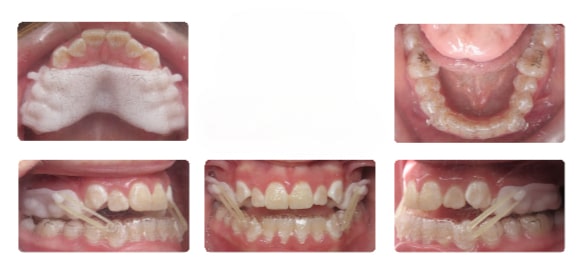
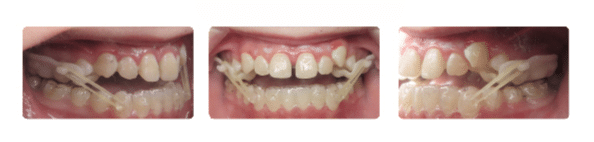
These two cases show Class III treatment with Invisalign Palatal Expander with hooks and the new Invisalign integrated buttons on the lower aligner.
Understanding the Posterior Bite Plate Effect
As Morris integrated the IPE into his practice, he discovered that the appliance behaves very similarly to a traditional bonded rapid palatal expander (RPE) due to the acrylic-like coverage across the posterior occlusion.
“When we use an IPE, it acts almost like a bonded RPE would act,” Morris explains. “So, we get a posterior bite plate effect just naturally with an IPE.”
This posterior bite plate effect proved to be a double-edged sword that requires careful case selection and diagnosis. Morris first noticed the phenomenon in an open bite case. After the patient completed a round of expansion and returned for progress photos and a scan for their Phase I aligners, Morris realized the patient’s 5-millimeter open bite had completely closed.
While the appliance worked beautifully for closing open bites, Morris quickly realized he needed to monitor his deep bite cases, as the posterior coverage was making those bites even deeper. To counteract this, he adjusted his treatment planning. He now routinely treats the lower arch with aligners from the very beginning of the IPE expansion phase, allowing him to fight the deepening of the bite while simultaneously developing the lower arch.
Redefining the Patient and Practice Experience
Beyond the clinical mechanics, Morris emphasizes that the IPE has transformed the consultation room and the overall patient experience. When presenting treatment options to parents, the visual difference between a traditional metal expander and the 3D-printed nylon IPE is often the deciding factor.
“If I show an Invisalign palatal expander versus a traditional expander, almost every time the mom’s going to go, ‘Is that that crank thing? Oh my gosh, my sister had one,’” Morris says. The smooth, custom-fit design of the IPE instantly alleviates the anxiety associated with turning a metal screw.
Beyond aesthetics, the removable design of the IPE empowers patients and parents by giving them a greater sense of control over their treatment—a factor Morris has found particularly valuable for very young patients and those with special needs. With a traditional, fixed metal expander, a child experiencing panic or discomfort can lead to late-night emergency calls from parents demanding it be removed immediately. “But you kind of empower the patient and the parent—you can take it out if you need to,” Morris says. “So there’s some freedom with that, that’s nice.”
This compliance-friendly design also translates to fewer emergency appointments for the practice. Because the appliance is simply a piece of plastic without springs or wires that can be bent or broken by sticky candies, the practice schedule remains much more predictable. If a bonded attachment happens to come off, it is a non-urgent fix that can be handled during normal business hours, which Morris calls a massive game changer for practice efficiency.
Back to Basics
While the addition of integrated hooks and the utilization of 3D-printing technology make the IPE a highly advanced tool, Morris frequently reminds his peers that it does not replace the need for foundational orthodontic knowledge. The appliance offers options in all three dimensions, but the clinician must still diagnose correctly, monitor the bite, and manage retention.
To make the transition to the IPE seamless, Morris advises orthodontists not to overcomplicate the technology, but to treat it exactly as they would traditional expander. For example, if the expander’s plastic wings irritate a patient’s palate, he handles it the way he would a Hawley appliance: simply trim it. He applies that same clinical logic to expansion and retention protocols.
“When you turn a Hyrax, it’s 0.25 millimeters; when you change an IPE, it’s 0.25 millimeters,” Morris says. “It’s a different appliance, but you’re essentially doing the same thing. I think it’s better and it’s efficient, but it’s just an expander. It just goes back to basic orthodontic principles.” OP
Dr Kent Morris’s Clinical Pearls for IPE Success
1. Prioritize tracking over speed. The IPE is designed to be changed daily, with each tray providing 0.25 millimeters of expansion, mimicking the turn of a traditional Hyrax screw. However, Morris warns that patients can get off track—everybody’s anatomy and wear time are different. If a patient comes in and their current expander does not fit properly, do not throw away the previous stages and do not rescan for a new appliance. Instead, have the patient go back through their previous expanders until they find the one that fits perfectly, and resume treatment from there. Morris stresses to parents that it is always better to go slower and remain on track than to go fast and lose the fit.
2. Rethink the retention phase. After achieving the desired expansion, retention is critical. Just as an orthodontist would hold a traditional expander in place for six months, the same principle applies to the IPE. To increase efficiency, Morris modifies his protocol. If a patient finishes active expansion at stage 21, he simply gives them stages 22 through 25 and holds for four to six months. This bypasses the need to immediately remove attachments, scan for dedicated holder appliances, and re-bond attachments, saving valuable chair time.
3. Keep the attachment template. The IPE system requires three posterior teeth on each side to be sufficiently erupted, and it utilizes two attachments per side for retention. The appliance ships with an attachment template. Morris advises practices to never throw this template away during active treatment. If a child accidentally knocks off an attachment, having the original template on hand saves the practice from a difficult and time-consuming re-bonding process. OP
Photos: Invisalign Palatal Expander images courtesy of Align Technology. Clinical images courtesy of Dr Kent Morris.
Alison Werner is chief editor of Orthodontic Products.