OrthoSelect CEO Steven Gardner outlines how the latest update leverages AI to accelerate case setups and tray printing, alongside a new concierge service that turns standard stock brackets into custom braces.
By Alison Werner
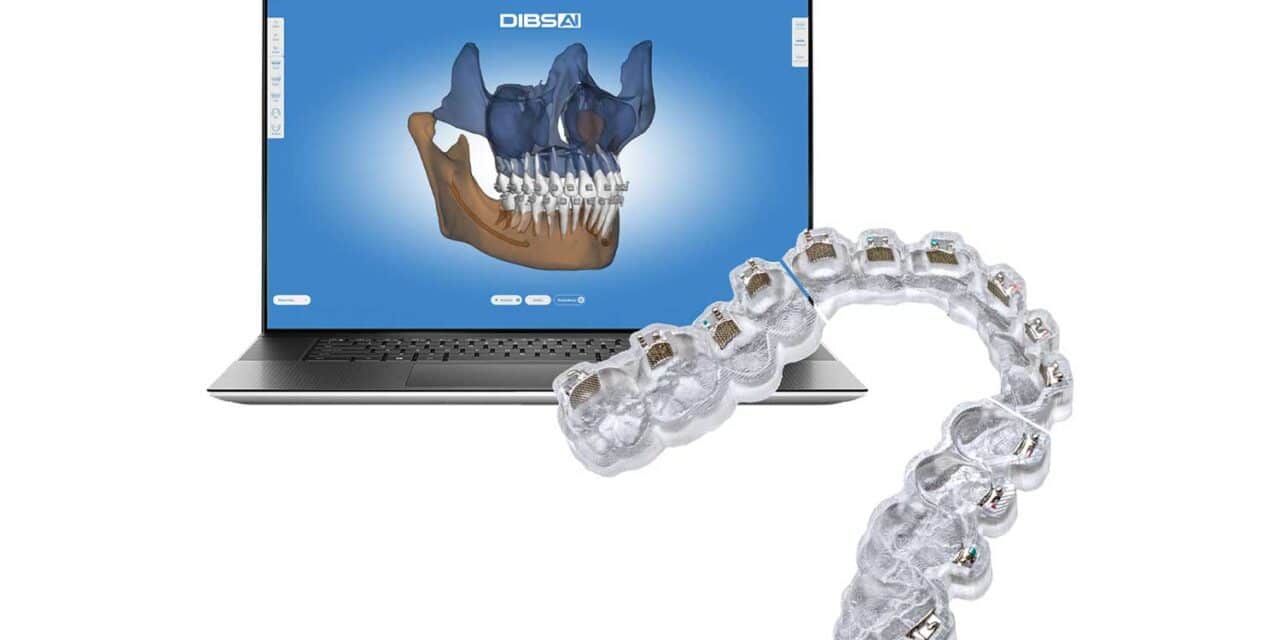
In the rapidly evolving landscape of digital orthodontics, software updates are frequent, but not all of them significantly alter a practice’s workflow. With the launch of DIBS AI Version 9.0, OrthoSelect aims to provide a more substantial shift. The updated platform introduces a suite of new tools—AUTO PHYSICS, AUTO SETUP, and AUTO TRAY—that leverage machine learning to streamline the indirect bonding process.
For Steven Gardner, CEO of OrthoSelect, the primary goal of this latest iteration is simple: deliver a better case setup for the doctor in significantly less time.
Off-Loading the Heavy Lifting to AI
Historically, digital indirect bonding required significant manual effort. Technicians spent hours orienting intraoral scans across the X, Y, and Z axes, cleaning up mesh files to remove saliva bubbles that could compromise tray fit, segmenting teeth, and applying brackets. If an orthodontist wanted a setup personalized to their specific methodology or bracket heights, they often had to do the digital homework themselves, adjusting teeth and brackets on screen.
DIBS AI Version 9.0 shifts this paradigm by using machine learning to handle the initial, painstaking steps of case preparation. The AI automatically identifies 244 tooth landmarks on the morphology, aligns the teeth to the desired archwire form, and places the brackets into an ideal Class I occlusion.
“Our big push for Version 9.0 was for the AI to take over that heavy lifting, all those early steps, so that when the technicians come in, the braces are already on,” Gardner explains.
By automating these repetitive tasks, the software frees up technicians to focus on the detail work and finessing. Instead of manually identifying teeth, technicians can now spend their time making minute, tenth-of-a-millimeter adjustments to bracket placement, ensuring tight posterior contacts, and personalizing the setup to the doctor’s exact preferences. Ultimately, this shift reduces the amount of time orthodontists spend in the software making their own adjustments before approving a case, giving them valuable time back in their day.
Keeping the Human in the Loop
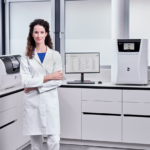
The integration of AI extends to the creation of the physical transfer trays. In the past, generating a 3D-printable indirect bonding tray that perfectly fit each tooth and bracket required hundreds of clicks and the use of multiple software applications. With the new AUTO TRAY platform, this process is automated in the cloud, creating water-tight, print-ready files that factor in the unique geometry of the chosen brackets.
According to Gardner, this automation has reduced turnaround times. He notes that in 2018, it took a technician roughly 45 minutes to manually design a set of transfer trays. Today, the automated system brings that time down to about three minutes.
Despite these leaps in automation, Gardner emphasizes that OrthoSelect will always keep a human in the loop. Every digitally generated tray is checked by a technician before it goes to the 3D printers.
“This nonsense of AI taking over jobs, we don’t subscribe to this,” Gardner says. “What AI does is it gives our technicians superpowers. They can do more.” Because the AI handles the repetitive tray generation, technicians are now cross-trained to assist with initial setups, 3D printing, and quality assurance, making the entire operation more dynamic and efficient, according to Gardner.
Physics-Based Predictions and Real-World Biomechanics
Another major update in Version 9.0 is AUTO PHYSICS, a platform designed to simulate real-world tooth movement. Rather than simply showing a digital animation of teeth magically snapping to a finishing wire all at once, the software now factors in the specific hardware being used, including the starting, progress, and finishing wires.
As Gardner describes it, the system uses extensive research on tooth movement rates to provide a more accurate treatment time predictor. Orthodontists can visualize how long it will take for specific movements to occur, such as leveling the curve of Spee or achieving proper torque, which typically only happens once the finishing wire is engaged.
To further aid in this physics-based planning, the software now incorporates synthetic roots generated through a partnership with Relu. While not a replacement for CBCT scans in critical treatment decisions, these machine-learning-generated roots give doctors and technicians, who may not have access to a CBCT scanner, a directional guide for root tip alignment, ensuring that both the crown and the root are positioned optimally.
Creating Custom Braces with the Signature Series
One of the most appealing aspects of the DIBS AI platform for many orthodontists is its bracket-agnostic nature. Doctors are not locked into a proprietary, premium-priced bracket system; they can use their preferred stock brackets, whether metal, ceramic, or self-ligating.
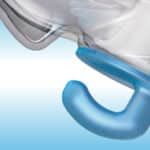
OrthoSelect is further expanding this flexibility by officially rolling out its Signature Series, which recently completed beta testing. The concierge-level service effectively turns stock brackets into custom braces. When the software determines that a standard bracket prescription won’t achieve the ideal torque or rotation for a specific tooth, technicians make digital adjustments that create small gaps or wedges between the bracket pad and the tooth surface inside the digital transfer tray.
When the orthodontist bonds the case, they fill that exact gap with adhesive, creating a custom base that perfectly matches the tooth’s curvature and forces the desired movement, according to Gardner.
“We’re going beyond just simple bracket placement. We’re getting into treatment planning. We’re really trying to figure out how to treat this patient as efficiently and as quickly as possible,” he says. “That’s really the big part of Version 9.0: reduce the repos, reduce the wire bending, and reduce the appointments.”
Overcoming Hesitations About Indirect Bonding
Despite the advancements in digital platforms, the vast majority of orthodontists still rely on traditional direct bonding. Gardner acknowledges that change can be difficult, and many doctors hesitate to adopt indirect bonding due to fears about workflow disruptions. A common concern is how to handle a debonded bracket without having to order an entirely new tray.
To address this, OrthoSelect now provides individual 3D-printed bonding jigs alongside the full arch trays. If a bracket comes off, or if a tooth was initially too crowded to bond, the staff can use the single-tooth jig to precisely place the bracket in its digitally planned position.
For practices on the fence, the true catalyst for adopting digital indirect bonding often comes down to physical ergonomics and staffing challenges.
“You have a lot of doctors whose backs hurt, their eyes hurt, they’re too busy, or maybe they lost some staff,” Gardner says. By utilizing indirect bonding, practices can cut bonding appointment times in half and delegate the physical placement of the trays to trained staff members, allowing the doctor to simply review and approve the final setup.
Putting Bonding Speed to the Test at AAO
To prove just how fast and accessible this workflow can be for both doctors and staff, OrthoSelect will host its Bracket Bonding Challenge at the upcoming American Association of Orthodontists (AAO) Annual Session in Orlando, Florida. Throughout the event, attendees can visit the company’s booth to time themselves bonding brackets to 3D-printed models using the DIBS AI transfer trays. The top competitors each day win prizes and advance to an NCAA-style, head-to-head tournament each day.
“It’s so fun to have that competition,” Gardner says, noting that the event consistently draws large crowds of cheering staff members. Alongside the tournament, the OrthoSelect team will be running demonstrations of the new Version 9.0 software to answer questions and offering exclusive sign-up specials for AAO attendees.
Maintaining Accessible Pricing
As technology becomes more advanced, costs often rise. However, OrthoSelect has consciously kept the price of its DIBS AI service at $165 per case, a figure significantly lower than many other custom digital bonding systems on the market.
Gardner attributes this price stability directly to the massive efficiency gains brought on by AI automation. Because the software handles the time-consuming data processing and tray generation, the company can process thousands of cases a week without proportionally increasing its labor costs.
“We want to give high value for what they’re paying,” Gardner says. While inflation may eventually necessitate minor adjustments in the future, the company’s core mission remains unchanged: to provide an affordable, bracket-agnostic solution that maximizes practice efficiency, reduces clinical chair time, and elevates the standard of orthodontic care. OP
Photo: OrthoSelect
Alison Werner is chief editor of Orthodontic Products.