Founder and CEO Khamzat Asabaev discusses the maturation of the aligner market and why orthodontists need an integrated ecosystem to manage complex biomechanics and improve case economics.
By Alison Werner
Recent industry data from sources like the American Association of Orthodontists (AAO) and Gaidge have indicated a slight shift in the orthodontic market, with aligner starts softening in certain regions while traditional braces continue to show steady growth. For some, this data might suggest a cooling of the aligner boom. However, for Khamzat Asabaev, founder and CEO of orthodontic technology company SoftSmile, these market signals represent a necessary maturation of the specialty rather than a rejection of clear aligner therapy.
According to Asabaev, the initial surge in aligner adoption was heavily driven by patient demands for aesthetics and convenience, coupled with the assumption that a majority of cases could be processed through a highly standardized, vendor-driven workflow. While this period of rapid growth was vital for the industry, it also illuminated the inherent limitations of systems that failed to provide orthodontists with sufficient visibility and clinical control.
“Braces still have a very important role,” Asabaev says. “They are reliable, culturally acceptable again for many teens, and often the right tool for certain movements or compliance situations. So I do not see this as braces winning and aligners losing. I see the market becoming more selective.”
Asabaev believes that the next phase of aligner adoption will be driven by platforms that prioritize the clinician, advancing only when systems can provide doctors with absolute confidence in their diagnosis, staging, force delivery, and overall case economics.
Solving Fragmentation in Aligner Systems
To address the limitations of early aligner models, SoftSmile was founded on a straightforward principle: doctors should control the treatment, and technology should exist solely to make that control more accessible and efficient.
The primary hurdle SoftSmile aimed to clear was workflow fragmentation. In many traditional aligner systems, the process is disjointed. An orthodontist submits patient records, waits for a technician to return a digital setup, and then engages in a time-consuming back-and-forth revision process. Throughout these cycles, the clinician often has limited visibility into the biomechanical reasoning behind the vendor’s proposed plan. This fragmentation costs practices valuable time and can ultimately compromise the predictability of the clinical outcome.
SoftSmile addresses this by combining its proprietary VISION treatment planning software, a collaborative portal, aligner manufacturing, and dedicated clinical support into a single, cohesive ecosystem.
“Because aligner treatment is a chain of decisions, diagnosis affects staging. Staging affects attachments, trimline, retention, force expression, and tracking,” Asabaev explains. “When software, manufacturing, and support are disconnected, important clinical details can get lost. We built SoftSmile as an integrated ecosystem to close that loop. Everyone is working from the same case data and the same clinical objective.”
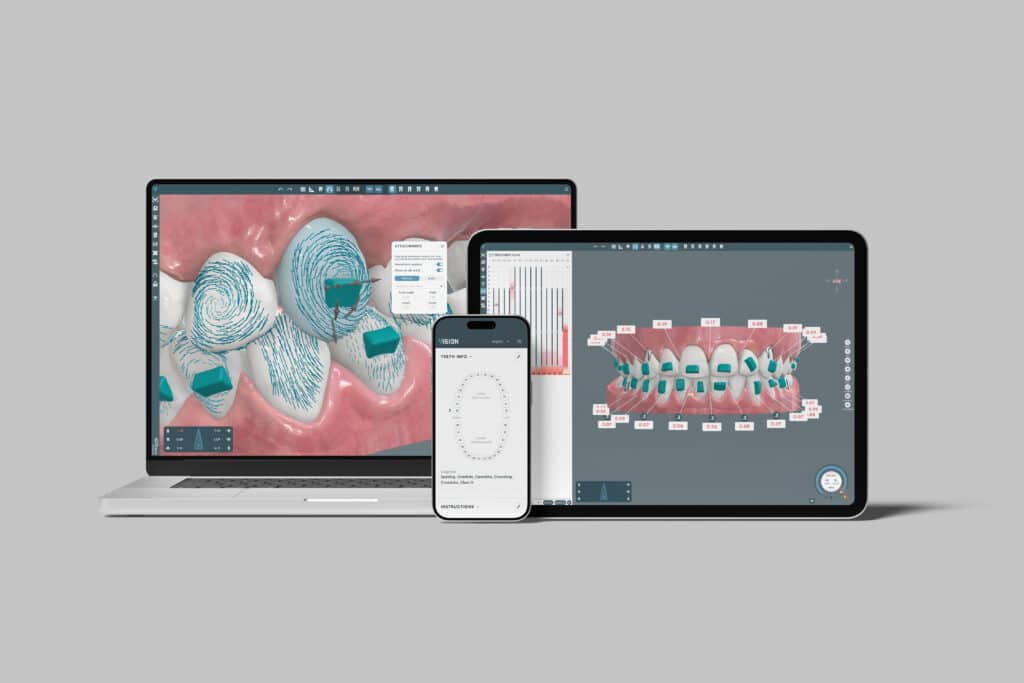
The VISION software includes a number of automated features, including Phantom for force visualization, BiteControl for analyzing occlusion and jaw displacement, and Staging Prime for informed movement sequencing.
Putting Clinical Control Back in Doctors’ Hands
Positioning itself as an “orthodontist-controlled” platform means that SoftSmile defers to the treating doctor as the ultimate clinical authority. While the software and support teams facilitate the process, the doctor retains the power to meticulously review, modify, and approve every aspect of the treatment plan, according to Asabaev.
For cases processed in the United States, digital setups are designed by experienced orthodontists on the SoftSmile clinical team, rather than by technicians who might simply apply a generalized template to a unique patient. This clinical foundation is deeply embedded in the company’s DNA. SoftSmile’s co-founder and clinical architect behind the VISION software, Dr Islam Raslambekov, is an orthodontist with extensive aligner experience who works directly alongside the engineering team.
“We aim to keep doctors’ plans, not the one that is convenient for a vendor,” Asabaev says.
The clinical core of this ecosystem is the VISION software, which replaces static treatment proposals and cumbersome written revision notes with a dynamic, visual environment. As Asabaev describes it, orthodontists can work directly within a platform built around true aligner biomechanics. The software incorporates advanced tools for segmentation, setup, staging, attachments, elastics, occlusion, and collision detection into one seamless interface. Since its launch, VISION has evolved to include automated features that preserve doctor control, such as Phantom for force visualization, BiteControl for analyzing occlusion and jaw displacement, and Staging Prime for informed movement sequencing. The platform’s accuracy was recently highlighted in a 2025 peer-reviewed study by Palone and colleagues published in Orthodontics & Craniofacial Research. The study, titled ‘Accuracy of Automatic Tooth Segmentation via Three Different CAD/CAM Orthodontic Software Packages: A Comparative Assessment,’ ranked VISION’s automatic tooth segmentation as the most accurate among studied systems, even in cases of severe crowding.
Tackling Complex Cases with CBCT Integration
The limitations of traditional aligner workflows often become glaringly apparent when practitioners attempt to treat complex malocclusions. When a system treats a complex case like a simple digital animation, critical biomechanical realities—such as torque, root control, rotations, vertical movements, and deep bite correction—can be overlooked, says Asabaev.
SoftSmile’s approach is to bring these biomechanical questions to the forefront before the patient ever begins treatment. A major component of this strategy is the integration of real CBCT data directly into the treatment planning phase.
“Traditional aligner planning often starts with crowns, because that is what the scan captures,” Asabaev says. “But orthodontists move teeth through bone, not crowns in isolation. Root position, cortical boundaries, alveolar housing, and surrounding anatomy can change what is safe, realistic, or efficient.”
By integrating CBCT data, VISION is designed to provide a comprehensive anatomical view that influences decisions regarding expansion, intrusion, bodily movement, interproximal reduction (IPR), and the pace of staging. This anatomical context reveals potential root collisions and ensures that the digital setup translates into a biologically sound clinical plan.
Reducing Refinements Through Upstream Planning
Refinements have long been accepted as a routine, albeit frustrating, part of clear aligner therapy. While acknowledging that biology and patient compliance will always introduce some level of unpredictability, Asabaev argues that many refinements are the result of avoidable upstream errors. Unrealistic movement velocities, weak anchorage, suboptimal attachment strategies, and occlusal interferences can all derail a case if not identified early.
SoftSmile shifts this analysis to the beginning of the workflow. The VISION software empowers doctors to thoroughly review staging, force visualization, and CBCT anatomy prior to manufacturing. Furthermore, during active treatment, SoftSmile’s Matching tool allows orthodontists to compare mid-treatment intraoral scans against the original digital plan to flag deviations early, providing an opportunity for proactive intervention rather than reactive refinement.
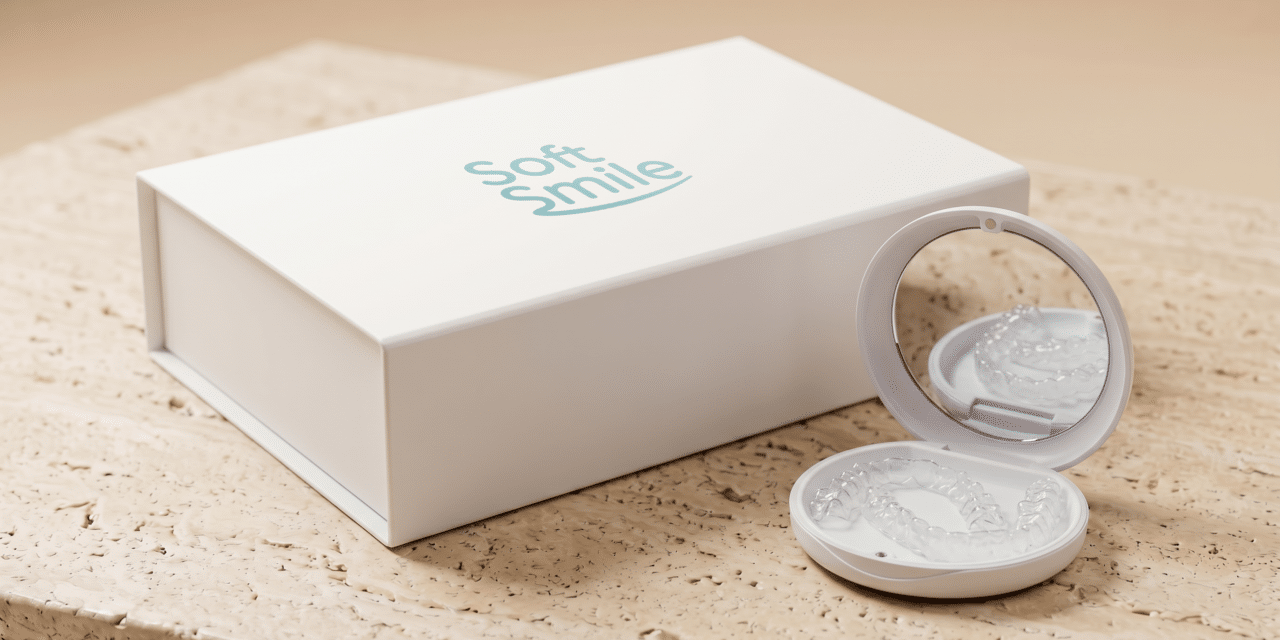
Once a plan is approved, the physical aligners are manufactured in the U.S. using a multilayer copolymer material designed for gentle, consistent force delivery. To ensure the physical tray accurately reflects the doctor’s clinical intent, attachments and trimlines are fully customizable. SoftSmile backs this production with a guarantee, promising delivery within 10 days of plan approval.
Rethinking Aligner Economics and Onboarding
When evaluating a new aligner system, practices must look beyond the initial lab fee. True case economics encompass doctor time, staff resources, the hidden costs of revision cycles, and the chair time consumed by unpredictable finishes and excessive refinements.
SoftSmile’s model is structured to improve these total case economics. By offering pricing below major competitors, flexible volume discounts, and operating without mandatory hardware or scanner lock-in, the platform reduces financial friction, says Asabaev. More importantly, the efficiency gained through the VISION software allows practices to review plans faster and reduce avoidable clinical errors.
For practices considering the switch, Asabaev emphasizes that onboarding is designed to be practical rather than disruptive. Offices can begin submitting cases using their existing intraoral scanners without overhauling their entire digital infrastructure. The onboarding process focuses heavily on capturing the individual doctor’s treatment philosophy, ensuring that from the very first case, the software aligns with their specific clinical preferences.
Ultimately, the platform is tailored for a specific type of practitioner. “The best fit is a practice that wants to own aligner treatment clinically,” Asabaev says. “The common thread is mindset: they see aligners as a serious orthodontic appliance, not just a cosmetic product. That is exactly the model SoftSmile was built to support.” OP
Photos: SoftSmile
Alison Werner is chief editor of Orthodontic Products.