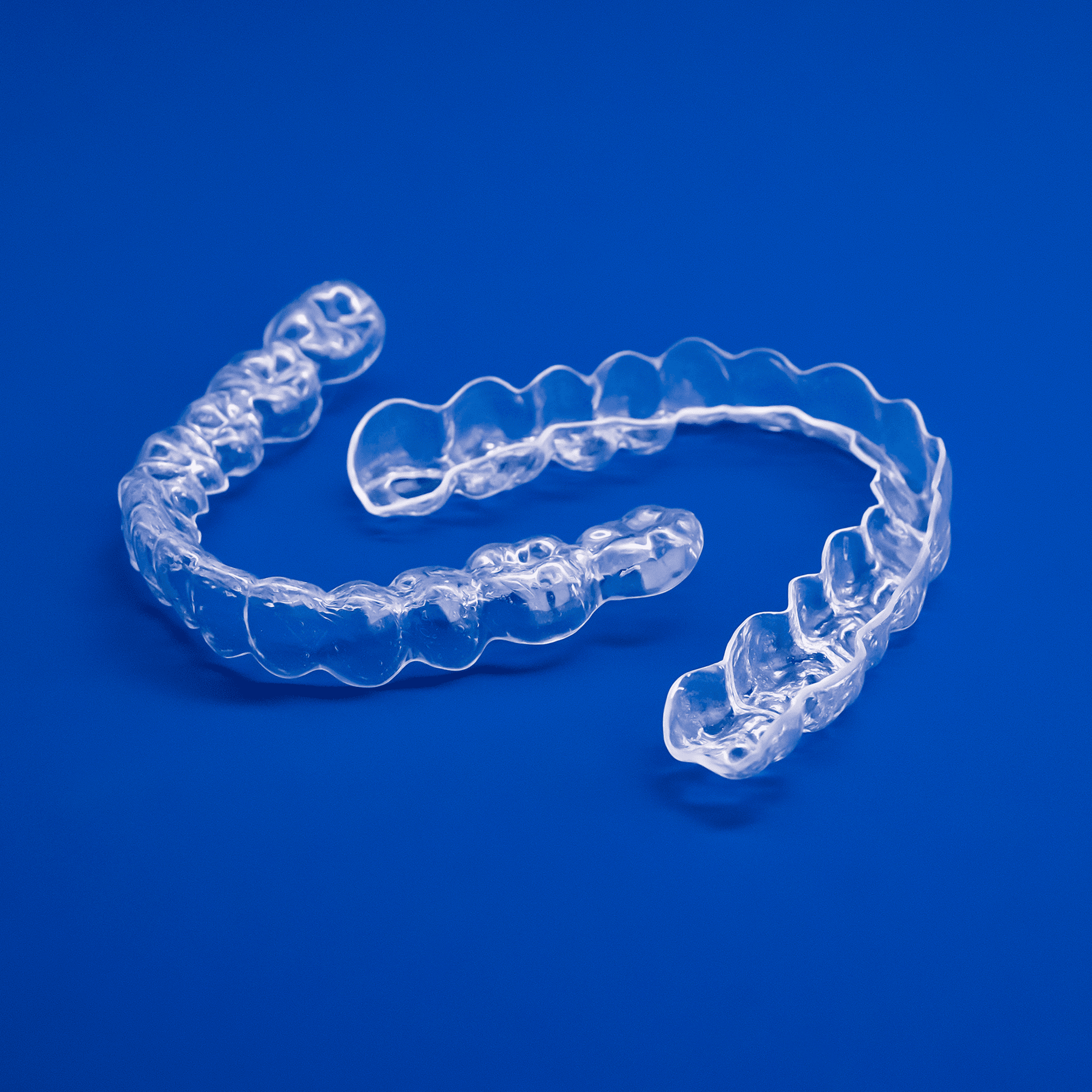

Preliminary results from a head-to-head clinical comparison with Invisalign highlight differences in treatment duration, aligner usage, and precision in mild-to-moderate cases.
By Alison Werner
A new retrospective clinical study offers the first head-to-head comparison of comprehensive treatment effectiveness between the OrthoFX FXClear aligner system and Invisalign, revealing potential advantages in efficiency and predictability for the FXClear system. The preliminary findings, announced by OrthoFX, show that in mild-to-moderate malocclusion cases, its aligners achieved significantly shorter treatment times, required 40% fewer aligners, and demonstrated greater geometric fidelity compared to Invisalign, all while producing comparable finishing quality.
The study, titled “Treatment Effectiveness of FXClear Aligner: A Comparison Clinical Study,” was conducted across three private orthodontic practices and evaluated 111 cases—54 treated with FXClear and 57 with Invisalign. To ensure a controlled comparison, all cases were treated by the same orthodontist using identical 7-day aligner change protocols and had similar baseline malocclusion severity (American Board of Orthodontics Discrepancy Index (DI) scores of 13.20 vs. 14.70; p=.056). The data positions the system as a proven alternative to the market leader, with researchers linking its material design to measurable gains in practice efficiency.”
A Closer Look at the Efficiency Gains
The study’s top-line results highlight several key metrics for practice efficiency. FXClear cases were completed in an average of 17.3 months, nearly six months faster than the 23.0-month average for Invisalign—a 25% reduction in treatment duration. This was achieved with significantly fewer aligners; FXClear patients used an average of 49 aligners per case, compared to 82 for Invisalign.
“Shorter treatment times, fewer aligners, and greater precision aren’t just numbers on a page,” said Sheila Tan, chief commercial officer at OrthoFX, in the company’s announcement. “They ladder up to happier patients and greater practice efficiency. We’re especially proud that this comparison was conducted under controlled conditions by the same clinician using identical protocols, because it reflects what’s really driving the difference: the proprietary polymer innovation behind our aligner system.”
The data also showed that FXClear cases averaged 12.6 total visits compared to 15.4 for Invisalign. This difference was driven almost entirely by a reduction in virtual monitoring visits (2.3 vs. 5.5). According to the University of Illinois at Chicago orthodontics research team lead by Phimon Atsawasuwan, DDS, MSc, MSc, MS, PhD, and Budi Kusnoto, DDS, MS, who analyzed the data, this reflects the realities of orthodontic workflow. Even when a case tracks well, essential chairside appointments for attachments, IPR, and finishing remain. “Where improved predictability really showed up was in the reduction of extra monitoring and troubleshooting, which is why the difference was much larger in virtual check-ins than in physical chair visits,” the team explained.
From Material Science to Predictable Outcomes
The 40% reduction in aligners with an identical 7-day wear schedule suggests that the difference lies in how effectively each aligner moves the teeth. According to the UIC team, the data indicates that FXClear tracked the digital setup more faithfully from the start, reducing the need for corrective stages later on. “According to the dataset, OrthoFX data showed less variability and fewer cases with larger localized discrepancies in both initial-vs-final and final-vs-predicted comparisons,” the researchers said in an interview with Orthodontic Products. “Our data support the predictability outcome favorably.”
OrthoFX attributes this performance to its proprietary polymer. “Conventional aligners are primarily made of more rigid materials. As a result, they are not designed to sustain the required forces throughout the aligner stage, quickly becoming passive soon after insertion,” explained Loc Phan, polymer scientist and co-founder of OrthoFX. “The proprietary technology used in FXClear aligners are designed to help move the dentition further along the prescribed movements before becoming passive, meaning the aligners have a longer working range than the standard aligners in the marketplace. This extended working range enables each aligner to deliver consistent, clinically effective forces over a greater distance of tooth movement.”
Addressing the Posterior Open Bite Problem
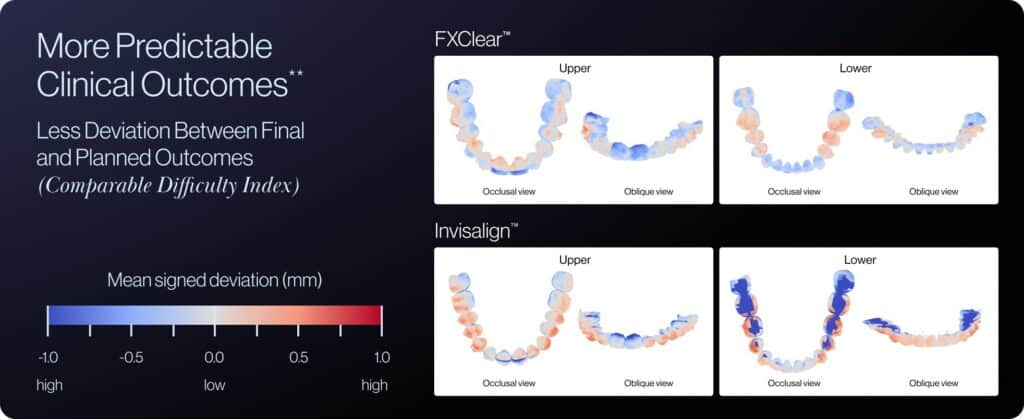
One of the study’s most significant findings for clinicians addresses a common challenge in clear aligner therapy: the posterior open bite. Using 3D superimposition to compare planned versus actual outcomes, researchers found that Invisalign cases exhibited deviations of up to 1.0 mm in the mandibular posterior occlusal surfaces. In contrast, FXClear demonstrated deviations of less than 0.5 mm in the same areas.
This was reflected in the Root Mean Square (RMS) deviation scores, a metric for 3D accuracy where lower values indicate a closer match between the planned and achieved result. The analysis showed FXClear achieved significantly lower RMS deviation in both the upper and lower arches. The UIC team told Orthodontic Products that the difference was not just in overall tracking but in where the errors accumulated. “Multiple OrthoFX cases showed tighter posterior agreement with the predicted setup, especially in lower arches and selected upper arches, with lower RMS values and better tolerance performance, making the aligner less likely to create unwanted vertical side effects in the back teeth,” the researchers stated. “Mechanistically, that likely means more stable seating and more faithful force delivery in the posterior segment.”
Implications for Digital Treatment Planning
While both systems achieved comparable clinical outcomes based on modified ABO Objective Grading System scores, the increased predictability of the FXClear system could change how orthodontists approach digital setups. The UIC research team suggests that greater predictability allows for more direct treatment planning.
“With less consistent systems, clinicians often compensate for the plan to avoid unwanted consequences in the setup—they overcorrect certain movements, stage more conservatively, or almost assume a refinement phase,” the team explained. “Based on the preliminary OrthoFX dataset we analyzed, our findings suggest that the digital setup can be treated more as a true treatment blueprint rather than an approximate first attempt. That does not eliminate clinical judgment from the orthodontists, but it shifts planning from defensive compensation toward more straightforward execution.”
Looking Ahead to Complex Cases
The current study was limited to mild-to-moderate, non-extraction cases, but the findings raise questions about how the system might perform in more complex scenarios. The UIC team expressed cautious optimism, noting that precision is even more critical in complex treatments.
“If a system performs more predictably in mild-to-moderate cases, it is reasonable to optimistically expect that advantage to become even more clinically relevant in extraction and other high-complexity treatments,” the researchers concluded. “That said, this study was not designed to prove that point. Our expectation is favorable, but it should be tested directly in extraction cases, significant anchorage-demand, and vertical-control cases before making definitive claims.”
The full study is currently being prepared for submission to a peer-reviewed journal. Until then, the preliminary data offers the orthodontic community a comparative look at how different aligner materials perform in clinical settings. OP
Photos: OrthoFX
Alison Werner is chief editor of Orthodontic Products.