
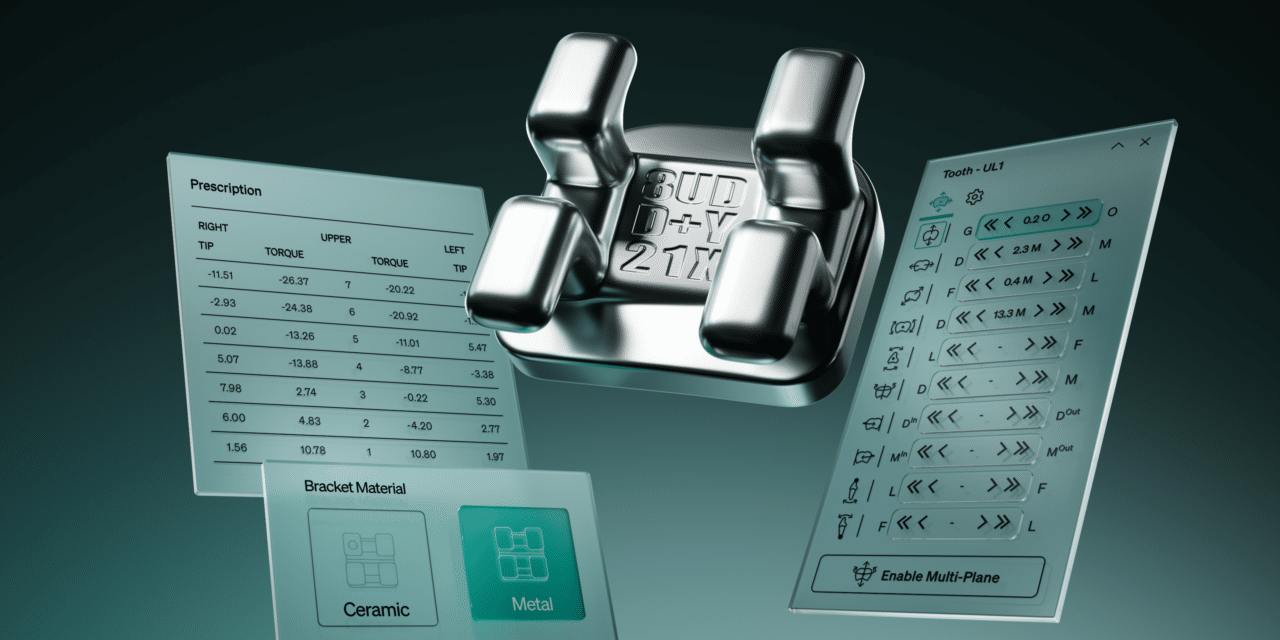
As the launch of LightBracket Metal brings 3D-printed, patient-specific customization to the largest segment of the orthodontic market, CEO Dr Alfred Griffin breaks down the engineering behind the new brackets and how the system is designed to eliminate clinical waste.
By Alison Werner
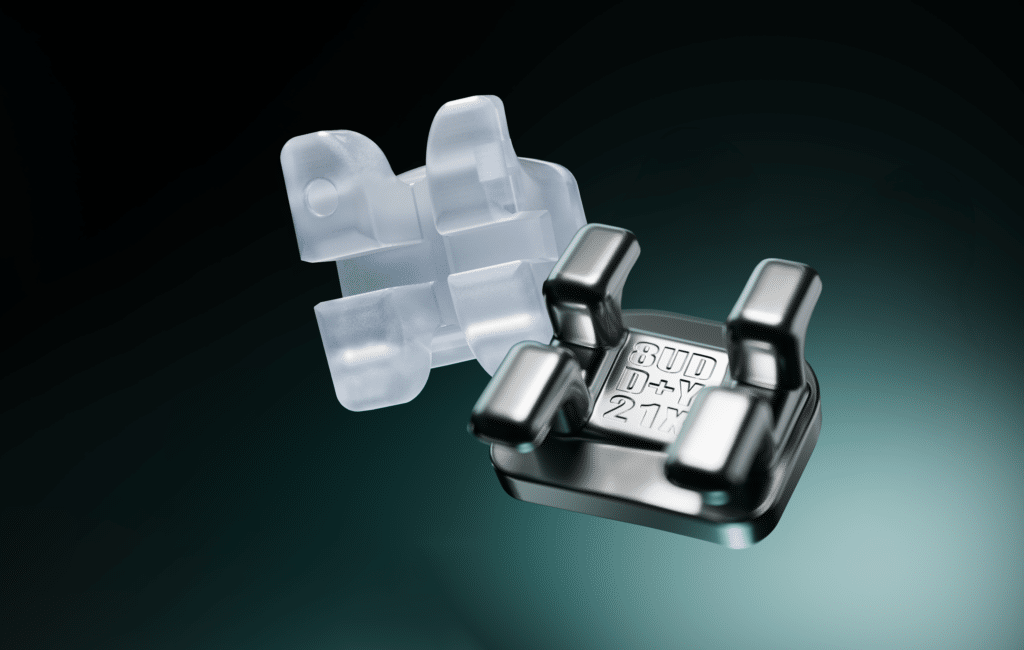
LightForce Orthodontics built its foundation on a radical concept for the fixed appliance market: 3D-printed, fully customized ceramic brackets. Now, the company is bringing that same personalized digital planning to the largest segment of the orthodontic industry with the launch of LightBracket Metal. Representing a significant expansion of access to individualized treatment, the first-of-its-kind patient-specific 3D-printed metal bracket is designed to address the 65% of orthodontic patients worldwide who choose metal braces.
The introduction of a metal option—slated to debut at the upcoming AAO Annual Session in Orlando, Florida—is not merely a material update; it represents a broader push to make customized, digital orthodontics the standard of care for all patients, particularly teens.
The Shift to Generative Braces
According to Alfred Griffin, DMD, PhD, MMSc, co-founder and CEO of LightForce, 3D printing is not the product itself, but rather the manufacturing mechanism that enables a new category of care: generative braces. “The reason we started with 3D printing was not because I love 3D printing; it’s because it’s the only way to scale this concept of generative braces, where information from the patient and the doctor can combine to make something bespoke and novel just for that patient,” Griffin says. “That’s personalized medicine.” Because the appliance is tied directly to the digital treatment plan, if the plan changes, the bracket changes with it.
Griffin notes that traditional injection-molded braces rely on a standardized catalog of sizes. In contrast, generative braces allow for the customization of all elements of the bracket. LightBracket Metal is individualized across six dimensions: the bracket base, slot height, slot prescription, bracket position, tie wings, and hooks. Three slot sizes are available (.018″, .020″, and .022″) with bidimensional combinations. The base conforms specifically to the morphology of the individual tooth, ensuring a precise fit and accurate torque expression that an injection-molded slot cannot consistently replicate.
Because the bracket is printed in exact layers from an STL file, the slot accuracy does not degrade over time, a common issue with injection molds that require slight divergence to eject the part. This precision ensures that the bracket an orthodontist sees on their software translates consistently into the clinical outcome for the patient.

Meeting the Demands of the Teen Market
While LightForce initially launched with ceramic brackets, expanding into metal with LightBracket Metal was always part of the company’s vision, largely to serve the teen demographic. Teenagers make up a vast majority of the orthodontic market, and approximately 95% of them receive metal braces, according to Griffin.
“One thing I underappreciated when we started this is that a lot of teenagers just want what their friends have. Their sense of self is informed by their peers,” Griffin says. “And, sometimes they want metal for aesthetic reasons.”
Beyond peer influence, metal offers distinct functional advantages for younger patients. Durability is a primary reason many orthodontists prefer metal, as it can better withstand the wear and tear of a teenager’s diet, such as chewing on hard candy. Additionally, metal brackets offer lower friction, which is highly beneficial during space closure.
LightBracket Metal Features Aimed at Patient Comfort
The transition to LightBracket Metal allowed LightForce to introduce new features aimed specifically at improving the patient experience—namely, fully customized tie wings and hooks.
“Our goal is to build the most comfortable bracket in the world, which should matter to patients, and it should matter in the TC room when you’re talking about the treatment you’re going to provide,” says Griffin.
To achieve this, the company addressed common clinical pain points. In a traditional setup, changing the vertical position of a stock bracket alters the angle of the hook, which can lead to it impinging on the gingiva or poking the patient’s cheeks. With generative braces, however, the hook is always bent at a custom angle, maintaining a functional, safe distance from the tooth and gingiva.
Furthermore, digital planning allows the bracket’s various components to work together to minimize its physical footprint.
“There’s this old debate in orthodontics: torque in face versus torque in base. That doesn’t matter anymore with generative braces because the tie wings, the slot angle, and the base all change in a synergistic way,” Griffin says. “It’s optimized to reduce the profile of the bracket.”
Ultimately, this lower-profile design not only enhances patient comfort but also serves to reduce debond rates by minimizing the lever arm effect on the bracket.
Leveraging Data to Refine LightTrays
A core component of the LightForce platform is how it utilizes data to improve both individual case outcomes and the system as a whole. This data-driven approach extends to the system’s indirect bonding trays, known as LightTrays.
Unlike traditional indirect bonding systems that take a one-size-fits-all approach, LightForce uses machine learning derived from roughly 200,000 patients and historical reorder data to pre-segment the LightTrays. The segments vary based on the clinical initial presentation of the patient, factoring in elements like spacing, crowding, or erupting teeth. This helps prevent the tray from rocking during seating or tearing upon removal, ultimately minimizing the number of surprises and bracket debonds, according to Griffin. However, in the event of a debond, every case comes with a pre-segmented backup bracket that can be placed immediately, and practices can reorder replacements at no cost.
“When you think about the technologies that we should bet on as an industry, it should be the tech stacks that will get better with new information,” Griffin says. “Anything that is 3D printed can change with new information. A platform that collects data on debonds will get smarter; it will inform products that make it more scalable.”
Clinical, Operational, and Economic Adjustments
Integrating a 3D-printed, patient-specific bracket system requires practices to adjust their workflows, but it also offers a chance to simplify inventory. Griffin notes that many beta testers highlighted the ability to consolidate down to just two systems for their entire practice: LightForce for all fixed appliances (both ceramic and metal) and their clear aligner of choice.
Clinically, staff members take on a more critical role in installing the hardware, requiring precise isolation techniques for delegated bonding. Because the LightForce platform tracks bracket replacements, the company can provide orthodontists with actionable data on staff bonding effectiveness. Over time, practices can review metrics on which team members have the highest or lowest debond rates, and even pinpoint specific areas—such as the left or right side of the mouth—where a staff member’s isolation technique may need improvement.
Operationally, practices shift toward 60-minute bonding appointments. Because the teeth are moving according to a precise digital plan, orthodontists do not need to be as reactive. Appointments can be spaced out to 10 or 12 weeks for initial wires, significantly reducing the total number of office visits. A recent clinical trial conducted at the University of Buffalo, and published in the journal International Orthodontics, highlights these operational shifts, showing a 43% shorter treatment time and 60% fewer appointments for patients treated with the LightForce system compared to conventional stock braces.
Economically, practices must prepare for a shift in cash flow. While the initial lab fee for customized brackets is higher, the reduction in patient visits ultimately leads to higher profit per visit. Griffin notes that practices typically experience a four-to-six-month cash flow adjustment period before seeing the full financial benefits of fewer appointments and shorter overall treatment times.
To help orthodontists manage this transition, LightForce provides dedicated onboarding support. The company shares data and modeling from a wide range of existing users—spanning from startups to large service organizations—to ensure doctors know exactly what to expect clinically, operationally, and economically before making the switch.
Scaling Responsibly and Eliminating Waste
The delay in bringing a metal 3D-printed bracket to market was not due to a lack of ambition, but rather the engineering challenges associated with mass customization. Early metal 3D printing was tailored for the automotive and aerospace industries, which did not require the exact surface finishes or tight tolerances necessary for a clinically efficacious orthodontic bracket.
LightForce spent years building its infrastructure with ceramic brackets, learning how to scale traceability—knowing not just which bracket goes to which patient, but which specific tooth—and maintain slot accuracy before applying those lessons to metal. Griffin stresses that scaling responsibly has been the company’s priority, ensuring that they maintain quality and precision on a part that must be exact every single time. As a result, LightBracket Metal is rolling out gradually to ensure the company can meet demand without compromising its manufacturing standards or the trust of its providers. Because initial availability is limited, Griffin advises orthodontists to reach out directly to their LightForce sales representative to inquire about access.
Ultimately, the introduction of metal generative braces is about refining the orthodontic process and removing historical inefficiencies.
“When LightForce replaces stock braces, tooth movement is not going to speed up biologically. The waste will just disappear—the extra appointments, the adjustments, the repositions of brackets, the wire bending,” Griffin says. “That was never part of treatment, that was the cost of using a tool that wasn’t designed for the patient.” OP
Photos courtesy of LightForce.
Alison Werner is chief editor at Orthodontic Products.






This was such a well-written article about the new era of braces and what’s next. Thank you for sharing and reporting on this. The LIghtForce booth was worth a visit too. Got a barista made latte in between all the crowds in their “born from light” booth.