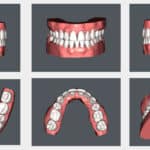

While customization alters mass-produced brackets, true generative braces leverage patient data and 3D printing to create bespoke appliances de novo for every individual tooth.
By Alison Werner
For half a century, the orthodontic industry has relied on the pre-adjusted straight-wire appliance. While digital workflows have revolutionized clear aligners, fixed appliances have largely remained tethered to mass-produced, stock brackets. While LightForce built its foundation on a 3D-printed ceramic bracket, the company’s recent introduction of 3D-printed metal brackets with LightBracket Metal has prompted a shift in how it defines its technology. By expanding beyond a single material option, LightForce is now framing its entire platform under a new category of orthodontic appliances: generative braces.
This transition represents more than just a new product launch; it is a shift in terminology that reflects a fundamental change in how fixed appliances are conceptualized, manufactured, and utilized within the clinic. The concept of generative braces extends far beyond a single material, moving the industry away from traditional mass production and toward true patient-specific generation.
Defining Generative Versus Custom
To understand generative braces, it is necessary to distinguish the term from customization. For years, orthodontists have customized treatments using stock brackets through indirect bonding setups, specialized wire bending, or digital positioning software.
Alexander Waldman, DMD, MMSc, of Waldman Orthodontics in Beverly Hills, Calif, notes that customization implies altering something that already exists, likening it to buying a suit off the rack and taking it to a tailor. “Customization is actually a word that is best used, I think, in reference to a straight-wire system that in some way is being enhanced,” Waldman explains. “Whereas generative is creating something de novo. It’s not being customized because it never existed before—and it will likely never exist again because this particular situation may never exist again.”
Generative braces, by contrast, are created entirely from scratch. According to Alfred Griffin, DMD, PhD, MMSc, co-founder and CEO of LightForce, a generative bracket is essentially the physical manifestation of all digital patient data brought into the physical world. The process relies on two distinct data sources: the patient’s unique anatomical data, gathered via intraoral scans, digital photographs, and CBCT imaging, and the orthodontist’s specific treatment plan.
“Those two things combine to generate something that will only fit that one patient to get them to the ideal end outcome—that’s the simplest version of what a generative bracket is,” Griffin says. Because teeth are as unique as fingerprints, this bespoke appliance is engineered to achieve a highly precise, individualized clinical endpoint.
The Limitations of Stock Brackets
The push toward generative braces stems from the inherent limitations of traditional manufacturing. Stock brackets are designed for the average patient, meaning orthodontists inevitably reach a point in treatment where the appliance no longer perfectly aligns with the patient’s unique anatomy or prescriptive needs.
Waldman explains that the traditional orthodontic process of repositioning brackets and bending wire is not actually a feature of treatment, but rather a workaround for a problem. Because stock brackets do not fit every tooth perfectly, clinicians spend significant clinic time compensating for those anatomical and prescriptive limitations. “We’re spending a lot of time with straight-wire orthodontics treating the appliance and not treating the patient,” he notes, which ultimately leads to busy schedules and extended treatment times.
“We have always accepted that as the process for braces,” Waldman adds. “But in truth, it’s not a process. It’s actually a problem.”
Furthermore, traditional brackets are typically manufactured using injection molding. Over time, physical molds wear down, which can lead to oversized or divergent slots. Griffin points out that because generative braces are 3D printed directly from an STL file, the digital file never degrades. This allows for the creation of a highly accurate slot that remains consistent from the first case to the millionth.
How Data Drives the Generative Process
At the core of generative braces is the continuous utilization of data. Much like generative AI draws from massive datasets to create novel outputs, generative braces use data to continuously refine both the appliance and the delivery system.
In traditional manufacturing, adding complex details to a bracket requires expensive new molds. With 3D printing, adding unique design features doesn’t cost extra. This design freedom allows LightForce to tailor multiple elements beyond just the base and the slot. In a generative system, the slot prescription, slot height, and even the angle of the tie wings and hooks are individually engineered. For instance, hooks can be angled at a functional distance from the tooth and gums to maximize patient comfort, eliminating the need for clinicians to manually bend them chairside.
The generative concept also extends to the indirect bonding trays used to deliver the brackets. Griffin notes that by analyzing data from hundreds of thousands of cases—including tracking exactly which teeth are most prone to debonds—the software can automatically segment the LightTray delivery trays to accommodate erupting teeth or severe crowding. This creates a system that gets smarter over time, utilizing supervised learning and clinical feedback to minimize variables during the bonding process.
Clinical and Operational Impact
For the orthodontic practice, transitioning from stock brackets to generative braces carries significant operational implications. The primary clinical benefit is predictability. When a bracket is generated specifically to fit a patient’s tooth and achieve a planned outcome, the need for reactive detailing diminishes.
Waldman reports that with generative systems, many of his cases can be finished without any bracket repositioning or wire bending. This predictability, he says, allows orthodontists to scale clinical excellence, achieving consistent, high-quality results across their entire patient base rather than just on select cases.
And while clinicians can achieve an excellent finish with traditional appliances, Waldman notes that the sheer effort required makes consistency a challenge. “It’s not a question of being able to achieve an excellent result with straight wire,” he explains. “You can put the work in and do it, but it is very hard work and it requires a tremendous amount of art and experience to mechanically wrangle that result out of a straight-wire system.” With generative braces, however, that clinical friction is removed. According to Waldman, the platform allows clinicians to consistently achieve excellent results in less time and with fewer appointments—outcomes he says were simply not possible with a straight-wire system.
Ultimately, when the waste of extra adjustments and wire bending disappears, the practice operates far more efficiently. Griffin notes that this efficiency is backed by clinical data, citing a recent clinical trial conducted at the University at Buffalo and published in the journal International Orthodontics that showed a 43% shorter treatment time and 60% fewer appointments—equating to more than 10 fewer office visits—for patients treated with the LightForce system compared to conventional stock braces.
The Future of the Orthodontic Workflow
The shift toward generative braces also alters the daily role of the orthodontist and their staff. By removing the constant need to manage the clinical chaos of rebonding and detailing, doctors can reserve their energy for the architectural phase of orthodontics—treatment planning.
In the clinic, the workflow is simplified. Staff take on a more critical role in bonding the brackets, similar to placing aligner attachments. And because the tooth movement is programmed into the generated bracket, Griffin says appointments can be spaced further apart, moving from reactive, frequent visits to proactive progress monitoring.
Economically, while the initial lab fee for a generative bracket system is higher than a box of stock brackets, the reduction in chair time and overall visits typically results in higher profit per visit. Griffin notes that the economics of the platform mirror the transition the industry went through with clear aligners. “The question is not whether it will generate more profit per case—it absolutely will,” Griffin explains, noting that while the higher initial lab fee can impact short-term cash flow, practices ultimately see a lower cost per visit and higher overall profit because patients require far fewer office visits.
Additionally, according to Griffin, the efficiency gained allows newer orthodontists to build robust practices with a smaller physical footprint and lower fixed overhead costs. This is particularly appealing to recent residency graduates managing significant student debt; because digital workflows reduce the need for multiple clinical chairs, they can generate the same level of revenue and profit with a much smaller physical office and lower fixed costs—meaning they no longer need a massive, six-chair clinic to build a highly successful practice.
As digital workflows continue to mature, the dividing line between fixed appliances and clear aligners is blurring. With generative braces, orthodontists now have the ability to offer a fully digital, personalized experience regardless of whether the patient chooses plastic or metal. By leveraging data to create patient-specific solutions, generative technology is poised to redefine the standard of care, stripping away decades of clinical compromises and allowing orthodontists to focus entirely on the patient. OP
Alison Werner is chief editor of Orthodontic Products.
Photo: ID 177798617 © Kanawat | Dreamstime.com